Police to Staff Ratios

According to Marc Pellerin, Vice President of the Winnipeg Police Association, in an article in the June 6th edition of the Winnipeg Sun, the  City’s answer to increased workloads in the Winnipeg Police Service is  “whipping the same tired ponies” to do more.    The Association advocates for more “ponies” and they may well be in a position to make that case.  The question is,  should they be police “ponies” or staff “ponies”.

Pellerin makes the observation that the City has funds available to pay overtime for  revenue generating activities that relate to traffic enforcement but lacks the funds for other activities such as investigations of serious violent crime.  The latter, although a major threat to the safety of Winnipeg’s citizens, does not generate cash flow for the city’s coffers as traffic enforcement does and instead represents a monetary drain.

In the overall context of staffing and workload there may be another more basic and fundamental issue at play here.  Cities, when setting police budgets, frequently use comparisons to other cities to justify either increased or decreased police related spending.  The most frequently used comparisons center around police to population and per capita cost of policing ratios.  Table 1 displays that information for Winnipeg and three other Canadian cities.

Table 1

City Police to Population Ratio Per Capita Cost
Winnipeg 1:491 $256.00
Toronto 1:471 $348.00
Edmonton 1:628 $305.00
Calgary 1:631 $265.00

Source:  Statistics Canada (2008)

There is one other ratio that has a very direct impact on police efficiency and effectiveness – the staff to police ratio.  Unfortunately, it does not garner the same attention as the number of police officers on the street.  It should, though, as the staff to police ratio is one of the determining factors as to what portion of their 10 hour shift officers spend on the street and what portion they spend in the office.   Table 2 shows that information for the same four cities:

Table 2

City Police Officers Support Staff Staff/Police Ratio
Winnipeg 1358 369 1:3.69
Toronto 5633 2895 1:1.94
Edmonton 1457 520 1:2.80
Calgary 1723 629 1:2.73

Source:  Statistics Canada (2008)

Part of the workload problem identified by Pellerin may not relate so much to the actual number of police officers as to the staff to police ratio.

Sometimes an analogy helps to clarify an issue.  Let’s use a restaurant as an example. For the sake of argument let’s assume that restaurants have only two classifications of employees, servers who take and relay orders and serve the food once its prepared, and cooks who receive the orders and prepare them.  The number of serving personnel and cooks required are determined by the demand ( in a police setting that would be the amount of crime and the number of calls for service).

Once the demand is determined the restaurant owner hires servers and cooks based on demand.

If there are too many servers and not enough cooks, the orders will be taken quickly but there will be a delay in the food being served as there is a backlog in the kitchen.  If there are too many cooks and not enough serving staff, there will also be delays – but for a different reason.  There will be delays in taking orders.  The orders, once they get to the cooks, will be prepared quickly but will sit and get cold waiting for a server to deliver them to the customer.

This is where the role of management becomes important.  Management must recognize the problem and balance the ratio of cooks and servers to achieve an efficient use of human resources.

What happens when management does not address this issue?  The cooks and the servers will step outside their assigned job functions to make the situation work despite management inaction.  The ‘system’ will attempt to self regulate itself and reach an equilibrium.

If you have too many servers and not enough cooks, the cooks will engage some of the servers to cook.  It the opposite is the case, some of the cooks will start serving the food.

So if the system will tend to self regulate itself, what is the problem?  It’s this: servers may not have the qualifications to be cooks and the quality of the food being prepared will suffer and invariably result in customer complaints.  Cooks may well be able to satisfactorily serve food but it is a poor use of resources as they are being paid at a higher rate than servers and to use them as servers in the long-term is not economically feasible.

In restaurants as in policing, the proper ratio is important.  Just as in restaurants if the police to staff ratio is not appropriate, either of two things will start to happen.   If you have too many staff members and not enough police officers the staff members will attempt to undertake ‘police work’ for which they are not trained.  On the other hand, if the ratio is skewed the other way and you don’t have enough staff, sworn police officers will through necessity start performing staff work just to get the job done.  This means fully armed and highly paid police officers will be in the police station performing administrative tasks instead of out on the street dealing with crime.  This is what is happening in Winnipeg.

Until the police/staff ratio is recognized as an issue and addressed,  police officers will spend too much of their time doing administrative tasks such as filling in forms, writing reports, and  filing.  In other words, administrative functions.

In Winnipeg the staff/police ratio is 1:3.69.  There is a reason why other police agencies strive for a ratio in the range of 1:2.5.  It relates to efficiency; it relates to effectiveness;  its part of sound human resource management; and effective use of resources.

The Mayor likes to add to the police complement (providing the Province is willing to fund the positions, of course) but it seems there is a hesitancy to bolster the number of support staff.  Eventually the imbalance in the police to staff ratio will jump up and bite you.  Actually, it already has.

Can a Police Helicopter Make Police Pursuits Safer

The short answer is yes, if it gets there on time.

In a recent article the expert on all things related to helicopters and photo radar AKA Winnipeg Sun columnist Tom Brodbeck again painted a picture for us on how peacefully vehicle pursuits in Winnipeg will end once the police Service has its helicopter.

It seems that every time there is a vehicular pursuit in Winnipeg that does not end well someone in the media makes sweeping statement about how this could have been avoided had the Police Service had its helicopter.  Police vehicle pursuits often end in collisions some with tragic consequences.  There is no doubt that with the presence of a helicopter some tragedies might have been avoided but a caveat needs to be attached.  The caveat is:

  • Had the helicopter been airborne at the time of the incident.

With an optimistic projection of 1000 flight hours per year the Winnipeg police helicopter will be airborne an average of 2.73 hours per day, that just under 12% of the time.  It becomes obvious that unless the police can convince auto thieves to only lead police on car chases during the hours the helicopter is in the air, the vast majority of chases will still need to be addressed using conventional methods.

An examination of vehicle pursuit data in Antonio Texas obtained by the San Antonio Express-News under the Texas Public Information Act revealed some interesting facts:

  • The San Antonio Police Department makes every effort to deploy a helicopter to all police pursuits.
  • Half of all chases end in 3 minutes or less.
  • In San Antonio the helicopter is able to assist in about one-third of all police chases.
  • Two thirds of the time the helicopter was either not in the air or tied up on other calls.

By the way, San Antonio has a fleet of four helicopters.

My original estimate that police in Winnipeg might be able to achieve a 12 per cent attendance rate may have been overstated.

The question that needs to be asked is not only how pursuits are ended but rather why they are initiated.  In a recent study titled Police Pursuits in the Age of Innovation and Reform (2008) available at http://www.theiacp.org/LinkClick.aspx?fileticket=IlJDjYrusBc%3D&tabid=392 the authors Cynthia Lum and George Fachner concluded that once the decision is made to initiate a pursuit in 72 per cent of the cases the outcome (in terms of how the pursuit ends) is almost entirely out of the hands of police.

This underscores the importance of having a sound pursuit policy that places realistic restrictions on the circumstances under which police will pursue a vehicle.  Secondly it underscores the importance of ensuring the pursuit policy is complied with.

Because police pursuits can result in tragic consequences they should not be undertaken lightly.

Maintaining the Public Respect

Some Short Term Pain for Long Term Gain

A recent column by Kevin Engstrom in the Winnipeg Sun caused me to reflect on an earlier post  dealing with the issue of police retaining the respect of the public.  It fits in well with Sir Robert Peel’s second principle which says:

To recognize always that the power of the police to fulfill their functions and duties is dependent on public approval of their existence, actions and behaviour, and on their ability to secure and maintain public respect.

Retaining the respect of the public is best achieved through openness, transparency and accountability.  If the police set and apply a different standard for dealing with members of the Service than would apply to a member of the public, the Service is well on its way to sliding down the slippery slope  of ethical decay and abandonment of their sacred public trust.

Some police agencies actually have a specific section in their media policy that deals with the release of information as it relates to police members who are charged criminally.  In most instances these policies require immediate release of information such as the officer’s name, rank, years of service, the charge as well as the officer’s current status with the Service.    That removes the temptation  to withhold information or any  attempt to ‘time’ the release so as to mitigate what the organization might see as negative media coverage.  In the long run the public support and respect garnered through openness and transparency  far outweigh any potential negative consequences.  The public is generally willing to accept that there will be limited instances of criminal activity by police officers.  They do, however, want to be assured that such behavior will not be tolerated and will be dealt with quickly, openly and fairly.  In other words:  that the police service is prepared to clean its own house.

Based on  Mr. Engstrom’s example, the Winnipeg Police Service would not appear to  have the appropriate media release policy in place, that is, one that requires immediate release of  pertinent information when an officer is charged.  Conversely, if they do have such a policy but are choosing to ignore it, then their behavior is  beyond merely ‘ethically sketchy’.

Either way, it’s a problem.

The below link is to Mr. Engstrom’s column.

http://www.winnipegsun.com/news/columnists/kevin_engstrom/2010/05/29/14188396.html

Westend Story


A really short play in one Act and one Scene

Act 1, Scene 1   Police officials and the mayor are gathered for a news conference outside the mayor’s office.  Representatives of Winnipeg’s print and electronic media are present to be briefed about recent violence in the West End

Police Public information Officer (shocked):  “We’re shocked.”

Chief of Police (sanctimoniously):  “These things cannot be tolerated.”

Mayor (indignantly):  “The public should be angry.”

Media Person #1              Can you explain to us why it is that you are shocked?  For those of us who follow crime in this city, especially as it affects the West End, what has happened these past days does not seem all that surprising.  Crimes of violence are not unusual in the West End.  How many shootings have there been in District 1 in the 5 month period since January 1st. 2010?

PIO                                         I don’t know off hand but I can get you that information.

Media Person #1              Your Crimestat website indicates 9 shootings since January and that’s up from 2 for the same period the previous year.  In the Daniel McIntyre Ward alone, Crimestat shows 5 shootings for that period – that’s up from 1 the previous year.

Media Person #1              How about muggings and sexual assaults?   Any idea how many of those offenses occurred in the Daniel McIntyre Ward?”

PIO                                         Again, I can get those numbers but off hand I don’t know.  In terms of the Crimestat Management and Accountability System, your questions on that topic should be directed to the Chief of Police.

Media Person #1              I’m starting to feel like I’m performing a public service here.  In any event I have those numbers and am prepared to share them with you if that would be helpful.   The long and the short of it is that there has been an abundance of violent crime in the West End and I’m surprised that you were shocked.

Media Person #1              Let me ask you, Chief: as you sat through the bi-weekly Crimestat meetings for the past 5 months and you saw the crime maps displayed on the screen depicting the  number of shootings and other violent crimes in the west end, did it occur to you that a trend might be developing?

Chief of Police                   Actually, I no longer attend Crimestat meetings.

Media Person #1              Fair enough, did your Deputy Chiefs report back to you on what was happening in the West End?

Chief of Police                   Actually they don’t regularly attend Crimestat meetings either.

Media Person #1 (shocked)              Surely, someone must have reported back to you about the violence in the West end as the crime maps went up on the screen week after week?

Chief of Police                   I have been told we no longer display crime maps at Crimestat meetings.

Media Person #1              That is something I would be interested in discussing with you at length.

Chief of Police                   Perhaps some other time.  This is not the time or place for that discussion.

Media Person#2               Chief, you indicated that what is happening in the West End ‘cannot be tolerated’ and have announced the assignment of additional resources.  There are other parts of the city that have levels of crime that are as high or perhaps even higher than the West End.  Will you be assigning additional resources to those areas as well in a proactive manner?

Chief of Police                   As you are aware, we are trying to do the best we can with the resources we have.  We would like to be able to have a greater presence in a number of communities but a ‘cop on every corner’ is just not possible.  We are concentrating our efforts, not just on having a presence.  We’re trying to build relationships within the community.  That is what it’s all about: building relationships.

Media Person #2              In your expert opinion, could the presence of a number of full-time dedicated beat officers assigned to the West End community have prevented these latest acts of violence?

Chief of Police                   It might have, but there is a real problem with assigning resources to prevention activities.  It’s very hard to measure their value because you are never able to truly measure their effectiveness.  How can you measure and put a value on something that did not happen?  The thing to remember, though, is that it is all about building relationships.  That is what I am committed to doing.

Media Person #3              Almost 200 years ago when Sir Robert Peel was charged with the formation of the London Metropolitan Police he laid out 9 basic principles to guide policing.  Are you familiar with those principles?

Chief of Police:                                  Yes of course I am, as are most police officers.

Media Person#3               I am specifically interested in your views on the first principle as it applies to the situation in the West End.

Chief of Police                   In what sense?

Media Person #3              In a general sense but  specifically do you agree with the principle?

Chief of Police                   I think we are getting side tracked here.  We are not here to discuss principles we are here to discuss what has happened in the West End and what we are going to do about it.

Media Person #3              Would it help if I read out what the principle says?

Chief of Police                   Let’s move on.  We are dealing here with reality not theory.

Media Person #4              Mr. Mayor, you have said that the people in the West End have a right to be angry and that they should be angry.  Who should they be angry with?

Mayor                                   They should be angry with the politicians in Ottawa.  We need harsher criminal laws to keep criminals behind bars.

Media Person #4              Should any of that anger be directed at the city and the police service whose job it is to police the city?

Mayor:                                 Absolutely not.  The city has worked hard to increase the number of officers on the street.  My, excuse me, I mean our, police officers under the guidance of the Chief of Police are putting their lives on the line every day.  Their efforts  should not be criticized.

Media Person #4              Increases in police complement over the past decade have been almost exclusively funded by the province.  Are there plans to increase the size of the Service further using city dollars?

Mayor                                   The city is not in a position to spend additional tax dollars on policing.

Media Person#4               And yet, in the last year the city (with assistance from the province) has spent or committed to spending approximately 5 million dollars on Closed Circuit Television and the purchase of a helicopter.  Some have suggested that is politically motivated pre-election spending that could have been devoted to increasing the size of the police service and putting dedicated foot patrols in high crime areas such as the West End.  What is your response to that?

Mayor (defensively and offensively)              That is a ludicrous suggestion.  I’m offended that you would even ask such a question.  There are serious issues at stake here and you are trying to turn this into a political issue.  And as you all know because I’ve said it many times, I am not a politician.

(The mayor, displaying his best exasperated look, motions to the PIO and the Chief of Police to follow him into the mayor’s office and they depart.)

The following is a link to the City of Winnipeg/Winnipeg Police Service Crimestat website:

http://www.winnipeg.ca/crimestat/whatisCrimeStat.stm

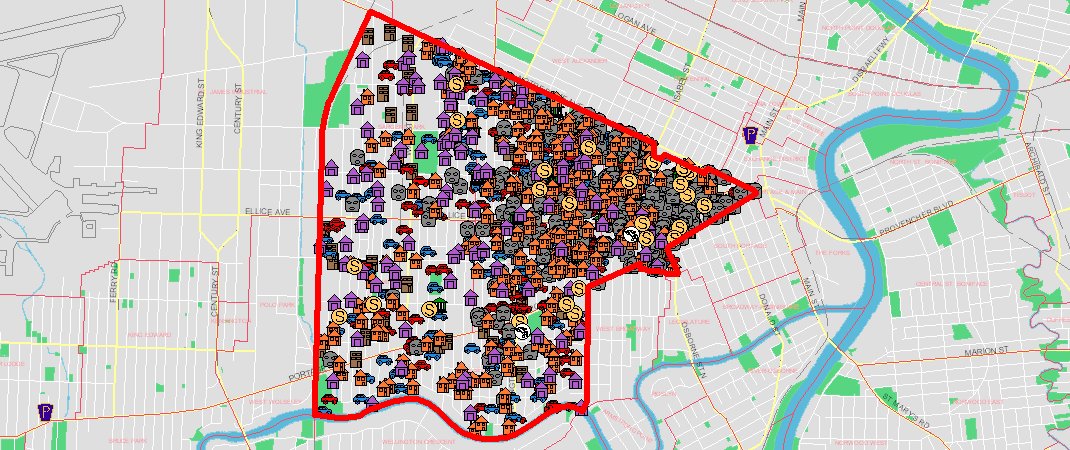
The map below displays reported crime for the ten offenses tracked by Crimestat for the Daniel McIntyre Ward for the period of June 2009 to May 2010

Source:  City of Winnipeg Crimestat website

A Lack of Operational Planning

Through a woeful lack of planning the Mayor and the Chief of Police keep managing to create a sense of urgency on funding police initiatives. First they managed to create a near panic about helicopter funding. Then they attempted to do the same with cadet funding stopping just short of calling the Province deceitful.  I’m starting to get used to the two of them standing together speaking with once voice, joined at the lip so to speak berating the Province. 

It may be time for the province to advise the Mayor and the Chief of Police that a lack of planning on the part of the City and the Police Service does not automatically create an emergency for the province. 

Perhaps its time for the City and the Police Service to put the things they are actually planning to do in the Business Plan and the Captial Budget.  If they did, and  then shared the document with the Province everyone would have a heads up on whats coming.  This would be helpfull for the Province especially as it relates to programs the City wants them to fund. 

An examination of the City’s Departmental Business Plans best exemplifies the City’s  lack of planning.

In 2008 the Police Service created and published its 2008-2010 Business Plan.* That document outlines the goals for the police service for the three-year period, and lists the strategies it will be using to accomplish its goals.

One would think that somewhere in that document one would find a reference to the Closed Circuit Television Cameras the mayor had installed in the downtown area. Surely they could not be funded and installed unless it was a police priority and identified as such in the business plan. Well they were not part of the business plan yet they were purchased and installed. Look up sometime when you are downtown. You’ll see them and even if you don’t, they will “see” you. 

Okay, maybe that one slipped through but surely the helicopter was part of the long-term business plan, or if not part of the business plan then in the capital budget. Wrong! Have a look at the 2008 and 2009 capital budgets. The helicopter does not appear there either.

Surely the reintroduction of the cadet program was part of the business plan. Wrong again!

If none of these initiatives were identified as priorities by the Police Service through the business planning or capital budget process, how did they get on the action agenda? It begs the question: whose agenda is being implemented? Does the agenda reflect the operational needs of the Police Service or the political needs of the Mayor in an election year?

 Perhaps I wrongly concluded at the outset that there was a lack of planning at City Hall and the Public Safety Building. Perhaps there is planning taking place it’s just that it’s political not operational.

*   http://winnipeg.ca/cao/BusinessPlanbySvc.stm

Force Option Decision Based on Politics

San Francisco Police Commission ignores  data during Taser debate.    

In a previous post I discussed the lengths the San Francisco Police Department had gone to  in examining its use of force policy, and to review the data on actual use of lethal force by members of the  Department  over a four-year period.  

The results of that review supported the introduction of a less than lethal force option (Conducted Energy Device) commonly know as Tasers.  The study showed that in five of the  cases where lethal force was used between 2004 and 2009, Tasers would have been a viable option.  In other words,  lives could have been saved.  A motion to introduce Tasers was recently debated by the San Francisco Police Commission and rejected.     

Reading between the lines one could conclude that the rejection of the motion was not really about Tasers.  Rather it seems to be about the power struggle between a new Chief of Police and the Commission.  George Gascon was brought in to implement change and he is trying to do that.  Some members of the Commission, however, see him as a threat to their traditional power base.  

The members of the Commission who voted against the Taser proposal could be accused of putting their own agenda ahead of public safety.  Yes there are dangers inherent in Taser use but what is the alternative?  I know if I were to be on the receiving end and were given the option of the Taser or the Glock, the decision would be quick and easy.  The choice is between the very slight possibility of serious injury and almost certain death.  

So why did the Commission vote the way they did?  I recently did a presentation at the University of Winnipeg on the Economic Model of Crime and one of the things discussed was the decision-making process that led to Council approval of the helicopter in Winnipeg.  I said at the time that politics trumps economics, every time.  In San Francisco we have a case where politics trumps data, evidence, and common sense.  This can happen anywhere but only when we let it.   

Politicians are our elected representatives and if they are acting out their fantasies or serving their own personal interests as opposed to serving the public will, election time serves as a good opportunity for the electorate to respond.

Winnipeg Police Physical Fitness – Part III

Making the Argument for on duty workout time

(This was originally intended to be a 3 part series but has now been extended to 4)

 If you are the police union and you want the City to give you something you must first establish that there is a need and secondly, how it will benefit the city.

The recent attempt by the Winnipeg Police Association (WPA) to get the City to give  police officers on duty time to work out was based primarily on the argument that criminals are coming out of jails bulked up and more fit than in the past. The answer according to the WPA is to grant police officer on duty time to work out so they can match the fitness level of the criminals they deal with.

Unfortunately the union failed to provide data to support their position. Although the data probably exists in terms of prisoners weight and musculature upon entering and leaving prison it’s not likely anyone can access it. The union might have considered making its case using other data.  If indeed there is a trend, historical data on assaults against police officers, injuries sustained by police officers resulting from physical confrontations, and Workers Compensation claims would assist in factually establishing what is happening on the street. Making a blanket statement that bulked up criminals coming out of prisons is putting police officers at greater risk  is not a convincing argument without  supporting data.

To support its position the union  brought forward examples of other western Canadian cities that are granting officers on-duty work out time. They mounted a political argument in a context where political arguments (as opposed to evidence based arguments based on data) are ineffectual. They can’t really be blamed though for trying this approach. They just saw the Service use the same approach and obtain funding for a helicopter from the City.

During the helicopter debate the Service  relied heavily on political arguments and anecdotal examples to support its position. The Service cited other cities that use helicopters as a basis for why Winnipeg should get a helicopter. They relied on various quotes from police officers in other cities about how  a helicopter in the air equated to a large number of officers on the ground to bolster their argument. It seemed this was particularly appealing and persuasive for the mayor. 

However, this is not a two-way street. The City decides which issues will be allowed to sail through city hall with an assisting political tail wind, and which will be held up to scrutiny. The Service’s helicopter proposal was largely political (based on wants not needs) but the Service had a benefactor who provided the tailwind. A true economic business case was not asked for nor provided.

That won’t be the case in this instance.  The union  will be required to make a business case (an economic argument) to support its position on the paid work out issue.  They will be required to provide evidence, data, hard facts not just anecdotes. It’s definitely more difficult to make your case when as Bob Seger says you are “running against the wind”.

The last post in this series will look at the  approach the union took on this issue and will examine the differences between positional and interest based bargaining.

Winnipeg Police Physical Fitness – Part II

The potential cost of the proposal by the Police Union in real terms

During the helicopter debate I discussed the concept of opportunity savings which in that context dealt with the number of officer hours that the introduction of a new tool or technology might free up.  The saving comes in the form of an opportunity to redeploy officers for a period of minutes or hours to a new duty from the duty they previously were engaged in.  Such redeployment is referred to as opportunity spending.  

In both the opportunity saving and spending scenarios the bottom line in terms of budgeted spending remains static.  Change is instead reflected in the activities in which the officer’s time is invested.  In order for the equation to remain truly static an opportunity saving must be created  before opportunity spending can be contemplated. 

The recent attempt by the Winnipeg Police Association (WPA) the union representing police officers in Winnipeg to get the city to agree to paid workout time as part of their regular shift is an example of opportunity spending.  

The union would argue that it is a no cost item as officer salaries (and the salary budget) would not increase.  From the union perspective it is simply a matter of time reallocation from regular duties such as uniform patrol or investigations to time spent working out in the gym.  They would argue that there is no real ‘loss’ to the city.  From the union perspective the city would be swapping patrol time for officers who would in turn be more fit and effective during the times they are on the street.  

Because the union proposal did not contain any ‘savings’  to be invested, there would be a significant cost to the city in terms of time diverted from regular policing duties to work outs.  For union/management bargaining purposes, this body of time needs to have a dollar value attached to it.   From the city’s perspective the starting point would be to calculate a dollar value based on a scenario where all eligible officers availed themselves of the benefit at every opportunity.  For the purpose of this discussion let’s look at a scenario where all 1328 officers employed by the WPS (based on the authorized 2008 complement) chose to take advantage of either a 20 or 30 minute paid workout period during each shift worked.     

The maximum amount of  time that would be consumed if all officers were granted 20 minutes to work out per days would be roughly 64 hours per year per officer.  Multiplied by the total number of officers that works out to approximately 84,000 thousand hours.  That is the equivalent to removing 40 officers from the street for a full year.  Add to that the 20 minutes of accumulated time that would be taken by the officer and the ‘street absence’ doubles to 168,000 hours or the equivalent of 80 officers per year.  

Under the 30 minutes per workday scenario it would work out to 96 hours per officer,  representing a total of 60 person years that the city would give up and once the additional time off taken by officers is factored in, it works out to losing the equivalent of 120 officer years of street duty.     

These calculations are based on the presumption that all officers work 10 hour shifts.  The fact is that many officers work 8 or 9 hour shifts.  For officers working the shorter shifts the cost would be significantly higher since they work more days per year and would therefore have more opportunities to avail themselves of the work out time.  The calculations are done on a worst case scenario from the city perspective, assuming all officers availed themselves of the work out provision at every opportunity.  The union  would argue that would not happen and that there would not be 100 percent uptake on the program.  They are  correct but in a scenario where you don’t know what would happen you need to establish what could happen (that is, the potential risk to the city).     

In dollar terms the opportunity spending cost of this proposal would be close to 2.95 million dollars for the 20 minute plan and 4.4 million dollars for the 30 minute plan.  This again is based on a worst or best case scenario (depending on your perspective) where each officer availed themselves of the workout period during each shift.  

The union’s position has consistently been that the city requires more police officers on the street.  It is difficult to mount a logical argument to expand the police complement when in the same breath you say that removing the equivalent of between 40 or 60 officers from active street duty would not negatively affect service delivery.

The next post in this series will examine the bargaining approach the union used in this instance and the difference between positional and interest based bargaining.

Winnipeg Police Physical Fitness – Part I

The cost of the existing police physical fitness program in Winnipeg

All Police officers hired since the late 1980’s are subject to a physical fitness standard as a condition of employment.  The standard which requires completion of drills and activities that simulate on the job activities such as speed, agility, endurance and strength must be completed within a fixed period of time.  Officers are tested annually.  Because progression through the various classes of Constable and promotion to higher ranks is tied to meeting the fitness standard, the compliance rate is high. 

Officers are further encouraged to meet the standard through an incentive program which gives officers who meet or exceed the standard 20 hours of time off annually.  Officers hired prior to the introduction of the mandatory program can enter the program on a voluntary basis and if they meet the standard, they too receive 20 hours of time off annually. 

If all officers availed themselves of this provision, it would result in the granting of 26,400 hours of time off annually.    At an average wage of $35.00 per hour, the dollar cost equates to just under 1 million dollars a year.   

Other fitness incentives for police officers offered by the City include gymnasiums in the Public Safety Building as well as in the other four District Stations and the Police Academy.  The City pays for the space, heating/cooling and general maintenance of these gymnasiums.  Much of the equipment was purchased by the Police Union and the ongoing maintenance and replacement of equipments is covered by a dollar a week levy that is assessed to all users.  The facilities located in operational police buildings are open 24 hours a day. 

The City also pays the cost of fitness passes to other city owned facilities such as the Sam Southern complex, The Pan Am Pool, the Cindy Klassen Recreation Centre and others for officers who prefer these facilities to a conventional gym.    The City also picks up the salary cost for the physical fitness coordinator. 

The overall cost to the city is in the range of 1 million dollars. 

Based on the recent attempts by the Winnipeg Police Association (the union which represents police officers in Winnipeg) to negotiate paid workout time through the media (a request which was denied), the union is clearly of the view that officers are not as fit as they should be. 

Subsequent posts will look at the cost of what the union was asking for and their approach to bargaining.

Operational Funding for the Winnipeg Police Helicopter

The following is Clause 1 of the Standing Committee Recommendation which deals with the funding of operating costs for the proposed Winnipeg Police helicopter which was approved by Council in January of 2010. 

That subject to approval of new incremental funding from the Province of Manitoba for all ongoing annual operating costs, estimated at $1.3 million in 2010 plus cost increases thereafter, the Winnipeg Police Service be directed to procure a fully equipped Flight Operations Unit together with a hangar to house the unit.  (Emphasis added is mine) 

Several key words are highlighted.  The first is all.  In his attempt to spin this scenario to  best advantage, the Mayor has talked about being agreeable to limiting increases to an agreed upon formula such as the cost of living or consumer price index.  On the surface that may sound reasonable, however, it only limits increases in expenditures to a percentage above the amount spent in the previous year.  It does not prevent the introduction of new expenditures.  The agreement binds the province to all ongoing annual operating costs.  The province would incur  full liability for expenditures it has no control over. 

This approach can be likened to the ‘we’re talking about less than 40 thousand dollars’ argument.  The mayor is essentially borrowing a line from the used car salesman’s handbook:  it’s the ‘if you are willing to spend $1.3 million, surely you’re not going to let this deal get away for a mere 40 thousand’ line.

The point that can not be ignored is that the province is being asked to enter into uncharted waters.  One question that needs to be asked and answered is, how firm is the estimated operating cost figure?  Why does that become important?  Because, based on the wording of the clause passed by Council, if the estimate is off by a couple of hundred thousand dollars the province will be on the hook for that as well. 

In the context of financial agreements and contracts ALL is a very inclusive term and can be a very expensive word.  And to top it all off, the phrase plus cost increases thereafter leaves the door wide open to additional expenditures that could be billed to the province.   The wording is much to loose.  A very careful, detailed and in depth examination of what is included in the estimate of $1.3 million for operating costs is clearly in order. 

To further bolster his argument, the mayor has pulled out and played the ‘lives are at stake’ card.  The fact is, that can be said about almost everything involving policing.  Police policy and procedure on vehicle pursuits, response to domestic violence, and use of force and a myriad of other issues can also put lives at risk – perhaps much more so than having or not having a helicopter.  But none of those issues are currently on the political radar nor are they likely to the subject of discussion as people cast their ballots in the civic election later this year.  The helicopter, on the other hand, is very much on the political radar.  In a political forum using an argument such as ‘lives are at stake’ can be  successfully employed as a  tactic because it strikes a chord with the public.  It is also difficult, if not impossible, to quantify or to either prove or disprove.  How can anyone argue against a move if failure to make the move could cost lives?  One can only hope that citizens (the electorate) see though this sort of gamesmanship and demand decisions and outcomes based on the merits of the issue versus the use of slick political spin tactics and rhetoric.    

If the city is not confident enough in its estimate of operating expenses to commit itself to a firm funding number they need to go back to the drawing board and rework their estimate.  Further, if they are not confident that the addition of a helicopter will produce at least enough savings to offset inflationary cost increases in the future years, then one might conclude that the rationale behind the entire proposal is flawed.  This is a classic ‘buyer beware’ scenario.  The buyer in this case is the province, which means all of us.