His Lips Were Moving

Recently, in an attempt to not raise property taxes the Sam asked all city departments to look at their budgets and come up with cuts.

According to news reports the Winnipeg Police Service was asked to come up with somewhere between $3 Million and $5 million.

There were, no doubt, provisos attached to the budget cutting instructions: you can’t cut the number of police officers;  you cannot cut the number of staff (which is already far below the acceptable ratio); you cannot cut the number of cadets; and above all you cannot ground the helicopter.

Once you look at the list of things that would not be politically palatable there are not many areas left (other than perhaps overtime) that could be cut that would yield savings in the $3-$5 million range.

The other option of course is to increase revenue.  Police departments don’t have many options in terms of sources that can dramatically increase revenues except fines.  Traffic fines to be precise.

According to a CTV report,  when Mayor Sam Katz was asked about a recent Winnipeg Police internal memo concerning the need to increase traffic enforcement the mayor indicated that the city is not behind the move by the Police Service to increase the number of offence notices issued (and the resulting increase in the revenue accrued to the City).

Apparently the mayor actually said, “To be frank with you, I’m not aware of that at all”.

Although I was not there and did not see or hear him say those words I’m willing to believe he said them and probably even with a straight face, but,  his lips were moving….. 

If a police department is given instructions to cut the budget but cannot touch the areas most likely to yield savings then the revenue side is the only option and traffic tickets are the prime revenue source.

“..not aware of that at all”,  Mr. Mayor?  What did you think would happen – the police would call on the friendly neighbourhood tooth fairy to deliver the goods?

School Zone Speed Limits – Part II

The motivation for conducting the poll on school zone speed limits was two-fold.  First,  I was curious as to how many people were of the opinion that  the current speed limit provisions were appropriate and how many felt they should be lowered.  Secondly, I was curious as to how many people would like to see some form of evidence that a change was needed as opposed to simply relying on the opinion of politicians or the police.

The results were as follows:  35% of  respondents had their minds made up and supported the proposed change without the need for any further evidence to support such a move.  On the other end of the spectrum 13% were prepared to leave the limits as they are.  The remaining 52% would like to see data as to the difference in accident rates between Winnipeg and other cities that have a 30KPH limits (30%) or they would like to see evidence that we currently have a problem with speeding and accidents involving children  in school zones (22%).  N=60.

That means that a full 65% of respondents don’t agree with the Chief of Police that it’s a ‘no brainer‘.

Now let me throw a couple of wrinkles into the debate.

The current speed limit in school zones is based on the posted limit on the street where the school is located.  Some schools are located on residential streets where the speed limit is 50KPH.  Others including both middle grade and high schools are located on major thoroughfares such as Portage Avenue, St. Marys Road, Main Street and Pembina Highway where the speed limit is 60 KPH.   Would it be appropriate to reduce speeds by half from 60 to 30 KPH in these streets?

The second wrinkle is the effect of already existing legislation.  Although there are speed limits, Section 95 (3) of the Highway Traffic specifically addresses situations where children are either on or near a roadway.  It says:

Reasonable and prudent speed

95(3)       No person shall drive a vehicle on a highway at a speed greater than is reasonable and prudent or in a manner that is not reasonable and prudent under the conditions and having regard to the actual and potential hazards then existing; and, without restricting the generality of the foregoing, no person shall drive a vehicle on a highway at a speed otherwise permitted under this Act where

(a) the presence of a child on or near the highway, whether or not he is in close proximity to the grounds of a school building or a playground, dictates, in the interest of safety, a slower speed or the temporary stopping of a vehicle; or

(b) any factor exists in the face of which failure to reduce that speed, or to stop the vehicle temporarily, constitutes a danger to any person or property visible to the driver.

(source: Manitoba Highway Traffic Act)

What this means is that police already have the authority to ticket drivers in school zones who are driving faster than the existing condition would make it prudent even if they are complying with the posted speed limit.

If speeding in school zones and safety are such a burning issue that the mayor is demanding the province make the amendments to the Highway Traffic Act  right now, then why are  police not enforcing the existing provision of the Highway Traffic Act in the interim?

Could it be that it’s about revenue under the guise of safety?

If the Mayor and the Chief of Police can convince the province to lower the speed limit they can then deploy their mobile revenue generating units (photo radar) and make a killing, at least in the short-term until drivers become accustomed to the new limits, especially in areas where the reduction would be 100% , from 60 to 30 KPH.

Funny that this whole issue should come to the fore when the city is looking at ways to cut budgets (or raise revenues).  I’m sure it’s just a coincidence.

Call me old-fashioned but I side with the province on this one in terms of ‘studying’ the issue before making the decision.

If the data supports the need for such a change I’m certain most Winnipegers would support it.

By the way, where is the data on this issue?  Two possibilities are likely.  The mayor and the chief of police have not asked for it, or they have asked for it but it does not support their position.  Despite the fact that in its strategic plan the Police Service purports to be committed to intelligence led and evidence based policing, there is no evidence such an approach is being implemented in this case.   As one of my colleagues used to say, ‘why confuse the issue with facts’.

Mayor Sam Katz’s Irresponsible Comment Quoted at WPA Arbitration Hearing

On January 17th 2012 I wrote a post about Mayor Katz’s irresponsible comments to the media.

An  article by Bartley Kives quoted the mayor as saying  “I can guarantee none of us would do that job for what they  get paid”.  This quote was in reference to Winnipeg police officers.

In my original post I suggested that the comment was inappropriate, especially during a contract negotiation year, and that the mayor’s remark would likely be used by the Winnipeg Police  Association to bolster its argument for a hefty pay increase.  I highly doubt the Mayor would make such a comment in relation to an upcoming negotiation that involved his own personal  money as opposed to public money.

On January 31st  2012 I briefly attended the labour arbitration hearing between the City of Winnipeg and the Winnipeg Police Association.

The day started with Keith Labossiere, the lawyer representing the Winnipeg Police Association, outlining for the panel, the reason why the Association believes its members  should receive an 11.5 % pay increase over two years.   Mr. Labossiere began his presentation by repeating the Mayor’s statement:

I can guarantee none of us would do that job for what they get paid”,  as the lead in for his argument.

Mr. Labossiere then launched into his presentation which gave me a real sense of  deja vu.  Having sat through many arbitrations previously I quickly realized the Association would be relying on the same arguments they have been using at arbitration hearings for the last decade.

I suppose, though, from the Association’s perspective, ‘why would you change your lure as long as the fish keep biting’.  The argument has worked reasonably well in the past.

The arbitration hearings are slated to continue  through  February 3rd 2012,  Millennium Room, Winnipeg Convention Centre and February 6th & 7th 2012,  Ambassador Room, Canad Inns Polo Park.

The hearings run from 9:00 am to 5:00 pm. and are open to the public.

Will the Winnipeg Police Association’s Endorsement of The Mayor Become a Cost to Taxpayers?

Perhaps a better question would be, how much will it cost us and are we about to be “SAMMED” AGAIN?

During the 2010 civic election the Winnipeg Police Association endorsed Mayor Sam Katz.  The announcement that the WPA was endorsing the Mayor coincidentally came on the same day that the Mayor announced he was adding 58 additional police and 19 staff positions  to the Police Service complement.  The  timing was  no doubt a coincidence (not) but it’s  one of those coincidences that voters have come to expect when an incumbent is running for reelection.  

Whenever unions support politicians there is some expectation that there will be a return on their investment.   Sometimes it is  favourable legislation, sometimes it is the creation of more positions which result in a direct benefit, in this case an increase in union dues (77 positions translates into approximately $40,000.00 in union dues – not exactly chump change).   In Canada one does not necessarily think about politicians meeting in hotel rooms and receiving brown paper envelopes stuffed with cash (e.g.  Karlheinz Schreiber and  Brian Mulroney) as a common occurrence.  Usually, at least in the cases that come to public attention it is less brazen.  The fact remains that when politicians make deals in return for support in the form of an endorsement there is  usually some form of quid pro quo.  Something is given, something is received.  Politics is not a zero sum game and politicians and their supporters are not totally altruistic. The unfortunate thing is that the  residual losses required to offset the gains realized by the players (in this case the mayor and the union) are absorbed by the public.

The Winnipeg Police Association already received what many observers consider to be, at the very least, a “down payment” in return for their support – that being the addition of 77 dues paying union positions.

Further, the association has been advocating for years, without success,  to amend the Winnipeg Police Regulations to allow for discipline records to be expunged.  A  few months  ago the association received what could be viewed as a ‘second payment’.    This time it was in the form of favourable legislation resulting in a change to the police regulations as it related to the expunging of discipline records.

Will the Winnipeg Police Association be receiving anything else?

They just might.  In comments to the media the mayor said that police in Winnipeg are under paid and  is quoted as saying, “I can guarantee none of us would do that job for what they get paid”.   Well, perhaps the mayor wouldn’t (he has never struck me as police officer material), but I think many others would, as illustrated by the number of applicants for police positions.   That comment coming from the lips of the mayor during a year when the City will be negotiating a contract with the Winnipeg Police Association could be worth a few bucks to the association.

With negotiations now at a deadlock, arbitration is just around the corner.  I’m willing to wager (only with the approval of the Manitoba Lotteries Commission of course) that  the Association’s lawyers will be using the mayor’s quote as the centerpiece in their attempt to  justify a larger pay increase.

If that scenario were to play out and the arbitrator were to be persuaded to up the award  by, say, a quarter to a half per cent, what would that cost taxpayers?  Answer:  in the range of $375,000.00 to $750,000.00, and that would just be in the first year.  Wage awards, because they are cumulative, are gifts that keep on giving.

That begs the question:  was the mayor’s comment a naive shot from the hip,  a mere slip of the lip or did we just get SAMMED again?

Crimes Committed vs Crimes Reported

The Winnipeg Police Service tracks 10 specific criminal offenses on Crimestat.

During the month of September, 2011,  Crimestat reported that  for those 10 specific crimes,  787 offences were committed, city-wide.

In  September 2011 the Winnipeg Police Service issued 26 News Releases.  In those 26 news releases, however, the Service made reference to only 10 of the 787 offences reported on Crimestat during September.

The table below shows the disparity between offences committed and offences reported on:

Crime Type Offences committed Offences  reported
Commercial Break-In 65 0
Break-In (other) 157 0
Residential Break-In 211 0
Homicide 3 3
Commercial Rrobbery 43 3
Non-Commercial Robbery 111 1
Sexual  Assault 16 1
Shooting 3 3
Auto Theft 109 0
Attempted Auto Theft 69 0
Total 787 10

It is of interest to note that the September 27th release makes reference to an arrest of a suspect  for 6 commercial robberies committed on September 16th and 17th.  Information that this robbery spree was in progress might have been of interest to merchants in the  area on the  dates when it was taking place.

This brings to mind Brian Kelcey’s recent op-ed in the Winnipeg Free Press in which he makes reference to running the City of Winnipeg on “spin”.

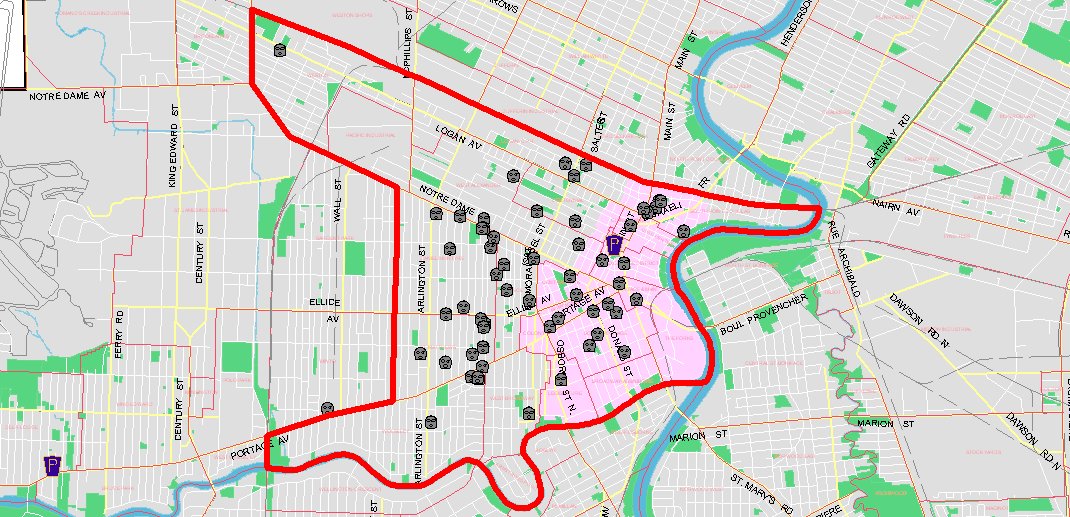
I suppose if the Police Service were to provide more information on muggings and sexual assaults it would become evident that the majority of those offences occurred in the downtown and the immediate north end of the city.  That would not be good for the image of the downtown which is being “spun” as safe.  During the month of September,  59 of the 111 muggings  reported city-wide were committed in District 1, which encompasses the downtown area.  The Crimestat map below shows what it looks like when these 59 offences are mapped:

Not a pretty picture and pretty difficult to spin.

When it comes to spin, George Orwell perhaps said it best, “He who controls the present controls the past, he who controls the past controls the future”.

Unpuzzling the Mayor About Downtown Safety

Air Canada recently put out a directive to staff instructing them to no longer stay in downtown Winnipeg hotels citing safety concerns.  According to media reports, our Mayor is puzzled by this move.

The Mayor,  other politicians and special interest groups with a  vested interest in the downtown, have for years been perpetuating the illusion that the downtown area of Winnipeg is a safe place.

I suppose Air Canada’s refusal to ignore the facts is what is puzzling the Mayor.

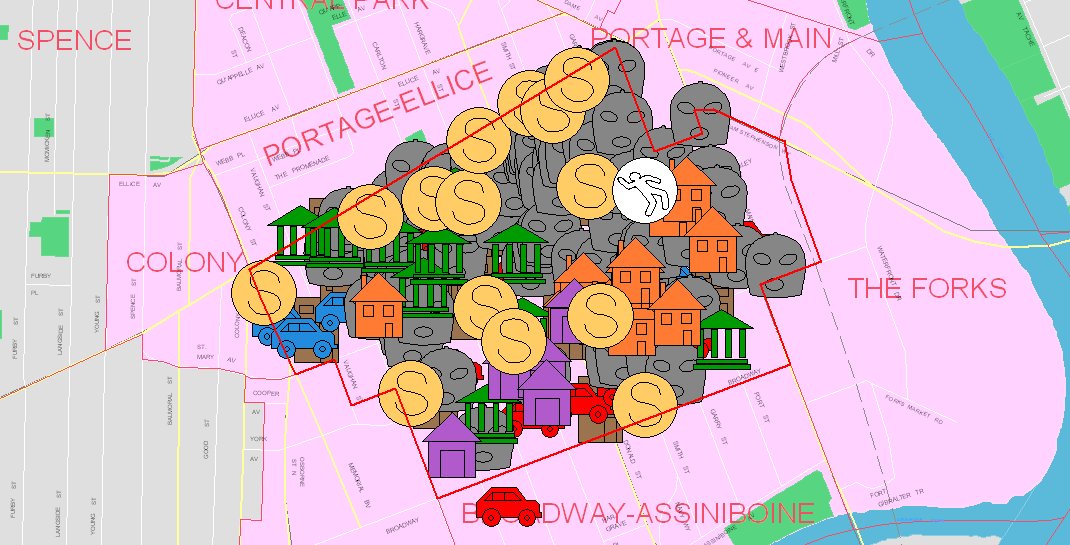
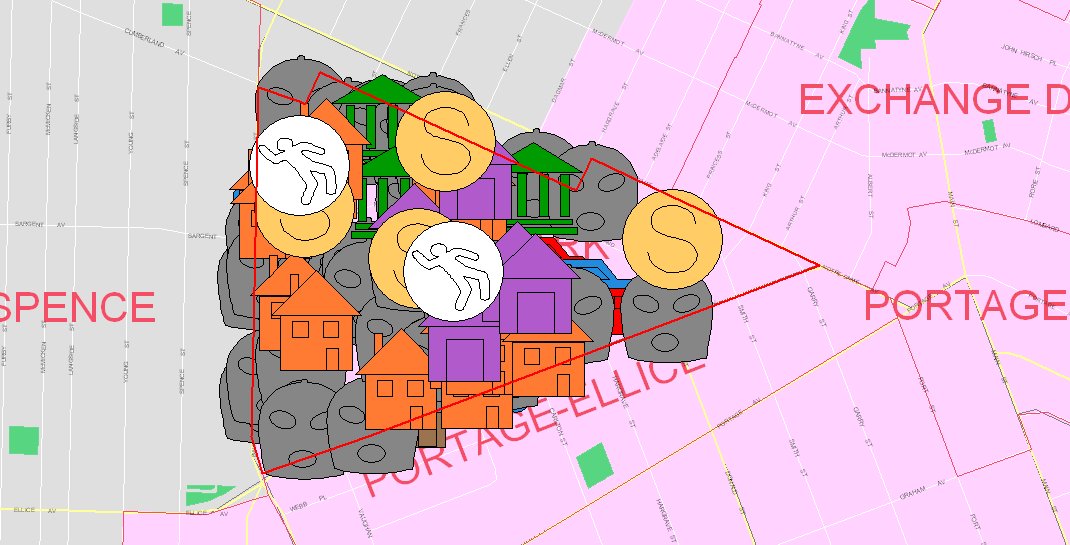
The Crimestat Maps that follow depict the 8 types of crime tracked by Crimestat for the period for October 1st 2010 and October 1st 2011.  Map 1 shows the Portage South Community, Map 2 the Central Park Community, and Map 3 the Portage Ellice Community.  The maps (and statistic tables) for those 3 downtown communities show that in the previous calendar year there were 4 homicides,  111  muggings,  and 24 *  sexual assaults.

Map 1

                                                               South Portage Community

Map 2

                                                               Central Park Community

Map 3

Portage Ellice Community

Now let’s have a look at the St. James Industrial Community, where the Ar Canada staff will be staying.  This area  had no homicides in the last year, 6 muggings and 6 sexual assaults and a smattering of other property crime.

Map 4

                                                              St. James Industrial Community

If you are still puzzled Mr. Mayor why not go for a walk with the Chief of Police to Portage Avenue and Main Street, pull your collective heads out of the clouds and look what is happening on Portage Avenue.  Alternately have a close look at Crimestat and ‘visit’ some of the neighbourhoods in the downtown and the immediate north end and ask yourself how safe you would feel to live there.  And finally, do something about it.

Stop spewing the election time propaganda that policing and the safety of Winnipeg streets is a provincial problem.  It’s not.  It’s a City of Winnipeg problem.  It’s your problem and a Winnipeg Police problem.  Do your job and provide appropriate policy direction to the Police Service and hold them accountable to address the issue of crime on the streets of Winnipeg.

*  correction to original post

Police Staffing Through Election Promises

Election promises at both the civic and provincial level have become the defining vehicle in terms of determining police staffing.

Announcing proposed increases to police funding at election time is not a new thing.  In the mid 1990’s the Filmon government made the first foray into this area by announcing that the Province would provide funding to expand the complement of the Winnipeg Police Service by 24 positions.  This was a purely political decision made at the Provincial level without any prior consultation with the Winnipeg Police Service.  As a matter of fact the Chief of the day was advised on the morning  the announcement was made and asked to attend the announcement to serve as ‘wallpaper’ for the Premier’s announcement.  The Chief of course, not wanting to ‘look a gift horse in the mouth’,  attended and came away with an additional 2 million dollars for the police budget.

Over the years, announcing police funding increases at election time has become the norm.  It has proven to be a sure-fire way to attract votes and win elections.

During the last civic election the Mayor used the same tactic.  Mayor Katz pledged increases to both police and civilian staff and was endorsed by the Winnipeg Police Association (WPA).  Some argued that the WPA  endorsement was contingent on the commitment to increase police and staff positions while others believed the increase in staffing to be contingent on the WPA endorsement.  Others insisted that the two issues were unrelated and the fact that the Mayor announced the staffing increase at the same time as the WPA endorsed the mayor was purely a coincidence.

As the current provincial election campaign gains traction it is interesting to see the bidding war that is developing as the two main contenders attempt to outbid each other (using our money) on the policing and law and order issue.

One of the major problems with politically motivated spending on policing is that additional money (positions) are allocated not by the police service but rather by the politicians to coincide with their current political priorities.

But that’s only partially the politicians fault.  Blame must also be placed with the police executives.

In the absence of a well laid out policing and crime deduction strategy with specific goals and costs attached, politicians jump into the fray and set the agenda.  To a degree they are simply filling a vacuum created by the lack of strategic operational leadership within policing.

As I have said before, what should be happening in terms of policing, crime reduction and police staffing is that politicians should clearly state their goals to police in terms of what they want accomplished, ie a percentage crime reduction across the board or in specific offence categories.

Police executives should devise a plan complete with broad goals, strategies and tactics that would be employed to accomplish the stated goals along with an  outline of specific areas of responsibility within the police service.  Such a plan would be accompanied with a price tag in terms of additional resources that would be required in terms of increase in personnel and other costs.

Once such a plan was developed politicians could decide if that is was they want and whether they want to fund it or not.  If the plan is adopted and funded,  accountability then exists between the police and the elected officials.

Until this happens we will continue to see money spent haphazardly, at election time, based on the political priorities of the day.

Sam Katz’s Latest Revenue Generating Plan

As a preface, if there is evidence that shows a traffic safety issue involving child safety in or near schools exits, it should be addressed.

When proposals on issues such as speed limits in school zones are brought forward by police the motivation is usually safety.  The same cannot necessarily be said when such proposals originate with politicians.  When politicians make such proposals, safety may be used as a facade to deflect the attention from the real objective which is often increased revenue.

Such may be the case with Sam Katz’s latest foray into “child safety”.

If this was a police initiative it would no doubt be backed by  statistics about speeding in school zones, accidents in school zones, and injuries to children caused by speeding.  If police suggested  a change to the speed limits in school zones,  politicians would demand such data to back up that position.

Sam’s proposal contains none of that.  No facts, no data.  Operational decisions are based on data, political decisions are based on politics.

At this point we don’t know if speeding in school zones is a major issue that requires a change in legislation.  The data (if it exists) has not been shared. What we do know is that the proposed change in legislation requires action by the province.  What better time to bring up what is on the surface  a ‘motherhood and apple pie’  issue than during an election campaign.  What provincial politician would want to be painted as being against protecting children?  None that I know of in Manitoba.

At this point we don’t know whether safety in school zones is a bona fide issue, but what we do know is that Sam’s timing is strategically impeccable.

As well, photo radar revenue which has been static or perhaps even declining after the construction zone cash cow was milked dry over the past several years, would receive a huge, if short-term boost as drivers adjust to the new speed limits.

If the speed limit in school zones is reduced I predict a lot of “flashes” at 7:00 AM and 9:00 PM on weekends and during weekends and summer holidays as the mobile photo radar units are deployed close to  elementary schools in residential communities.   There is potential for revenue even if there are no kids around (the safety issues it is supposedly designed to address).

Even if there are no kids around the schools during the early morning or late evening hours on weekends or during the holidays, the photo radar cameras don’t know that (although presumably the operators do).  The city’s ‘money printing machines’ ( photo radar units) will be on overtime if this proposed change becomes reality – and all in the name of protecting children.

I think we are about to be “Sammed” again.