2010 Winnipeg Police Annual Report – Not

Annual reports can be very useful tools, generally providing a review of the previous year’s performance. Like most major corporations, the Winnipeg Police Service releases an annual report.   Based on the late year release of the 2009 Annual Report – it wasn’t made available until December 2010 – one can anticipate that it may be another 11 months before the public and media see the 2010 Annual Report.

Eleven months after the fact is a little too late to get crime statistics.  After 11 months, statistics, especially crime statistics, are old,  stale and  really of little if any use if one wants to analyze them and effect any meaningful change.

So if you want a statistical  preview  of  the 2010 annual report visit the Crimestat website and click on ‘view report’.  Unlike the Annual Report (i.e. the official ‘picture book’ version), the website has no glossy pictures of helicopters and guns (the preoccupation of the mayor and current police executive).   You can look at the pictures, however, when the actual  annual report comes out in December.  If, of course, that’s what you’re after.

The ‘star’ again this year driving the  majority of the 8% reduction in the crimes tracked by Crimestat was the award winning  Winnipeg Auto Theft Reduction Strategy, the evidence based and data driven strategy that was implemented in 2005.

Just Answer the Question, Sam

When I read Bartley Kives’ interview with Mayor Sam Katz in today’s Winnipeg Free Press where Kives asked the mayor about the murders in the north end, two things came to mind: firstly,  the answer does not fit the question, and secondly, in the words of Shakespeare, he  “doth protest too much, methinks”.

It is not unusual for politicians to avoid answering questions put to them by the media.

What is unusual (and curious) is when  politicians offer up information that although not relevant to the question invites all kinds of other questions while revealing  their insecurities and self doubt about the things they are doing.

In his year end interview with the Mayor, Bartley Kives asked the Mayor a simple question:  FP: How do you feel about the unsolved triple shooting at the end of October?”

The Mayor’s reply was It was not a good day in the City of Winnipeg, I’ll be blunt with you. I assume (the police) are still doing their investigation and will come up with information and hopefully solve it. For all I know, they could have suspects as we speak. But I don’t know, because I don’t interfere with police investigations. I have never done it before and I have no intention of doing it right now.”

Let’s analyze the part about the shootings not being “…a good day in the City of Winnipeg…”

He seems more concerned with the overall image of the city, but is this the time to be worrying about it in this context?!  What kind of day do you think it was for the 3 people who were shot?  What kind of a day to you think it was for their relatives, friends and neighbours?  What kind of day do you think it was and still is for the neighbourhood where the random shootings took place when they are advised by police that they couldn’t protect them and they should stay in their houses?

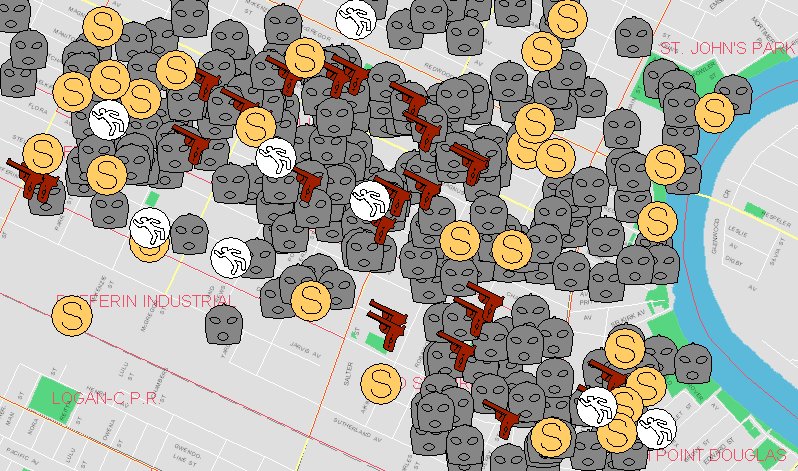
When you look at the Crimestat map depicting homicides, shootings, muggings and sexual assaults in a few of Winnipeg’s north end communities, it’s readily obvious that it’s been awhile since those communities have had a “good day in the City of Winnipeg”.

Winnipeg Police Crimestat (depicting homicides, shootings. muggings and sexual assaults  between January 1st 2010 and December 27 2010)

The mayor went on to say “I assume (the police) are still doing their investigation and will come up with information and hopefully solve it. For all I know, they could have suspects as we speak.”

Unless the mayor is not reading the briefing notes he is sent (or dozing off during his weekly briefings with the chief of police), there is no need for him to make any such assumptions on the progress of an ongoing investigation. To suggest he is taking a disinterested ‘hands off approach’ in terms of the progress of this investigation means he is either a fool or he is negligent.  Politicians need to keep themselves informed and abreast of what is happening.  To pretend otherwise is cause for concern.  The mayor can and should be kept informed about the progress in an investigation of this magnitude and it can be accomplished without piercing the ‘sacred veil’ of police operations.

Lastly, the Mayor says:  “But I don’t know, because I don’t interfere with police investigations. I have never done it before and I have no intention of doing it right now.”

Where is this comment coming from?  Where in the interview is it suggested that he has or may be interfering with police investigations? Why the unsolicited denial?  Even the layperson knows that there is a big difference between being briefed and being kept aware of the progress of police investigations, and interfering in them.  Politicians should keep themselves informed, and they must not yield to the temptation to interfere.

The mayor then qualifies his statement further by saying he has never done it (it being, interfering with police investigations) and that he has no intention of doing it right now.  Never is a pretty strong word. All inclusive, leaves little wiggle room, little room for interpretation. Never means never. Not even once.

The mayor says he will not interfere with the ongoing police investigation “right now.”  Does that mean he is reserving the right to interfere in this or other police investigations in the future?

The New Winnipeg Stadium – The Real Cost to Tax Payers

The Mayor is quoted as saying that for an investment of only 6% of the overall cost of $190 million, Winnipegers are getting a new stadium.

That 6% is made up of 10 million dollars in outright grants from the city, and 1.6 million dollars in new infrastructure requirements at the new stadium site.

That’s 11.6 million dollars.

A further 1.1 million dollars in the form of  ‘in kind’ services for building and development permit fees is thrown in as a freebie.

The Mayor is right.  If the $1.1 million in in-kind services is ignored, the $11.6 million works out to approximately 6 % of the overall 190 million dollar estimated cost of the new stadium.

Now if that were the real cost to Winnipeg tax-payer, that would be a good deal.

However, the Mayor (as he frequently does) is telling only a portion of the story.

The City is on the hook for a further  75- 85  million dollars (depending on which numbers you look at) which will be repaid using tax dollars generated through the Tax Increment Financing scheme once the site of the current Winnipeg Stadium is sold and redeveloped.

Because this is new money,  the mayor has conveniently chosen to ignore it.  If this additional money (cost) is factored into the City’s contribution to the stadium project, the total cost to Winnipeg tax payers is in the range of  87 million dollars.

That ups the City’s percentage contribution to the project from 6% to 46%.

In the words of Brian Kelcey,  a former advisor to Mayor Katz, the mayor and councilors need to remember that:

“Just because it’s new money, doesn’t mean it isn’t real money”

Taking into account the true cost to Winnipeg tax payers, is this still a great deal?

Stadiums, Marijuana and Photo radar.

Putting the power in the hands of the people who live with the consequences and pay the bills.

Americans are different from Canadians – we all know that.

Their system of government and governance is different as well.  Americans are more likely to demand a direct say in what their governments do at all levels but especially at the local and state levels.

Canada has a different form of democracy, less direct, less hands on. We have a parliamentary system of government; America is a republic.  Under both systems the representatives of the people, once elected, make decisions on our behalf; decisions that may or may not reflect the views and values of their constituents.

Referendums allow the people to have a direct say in what the law should be and which projects should be funded. What a novel idea.

In Canada referendums are rare.  In the United States, referendums are  common and used as tools to guide politicians in terms of what the people want.

The recent mid-term elections in the United States featured many local and State referendums.  The following are of some interest.

In California, Proposition 19, if it had passed, would have seen the elimination of all criminal penalties for adult Californians (21 years of age) who planted marijuana plots up to 25 square feet or possessed up to one ounce of marijuana for personal use.  The proposition did not pass (54 % opposed) but organizers are already planning to put the issue back on the ballot for 2012.

In South Dakota, Measure 13 would have allowed for the medical use of marijuana .  It was defeated with 60% of voters rejecting the measure.

In San Diego, Proposition D, which would have increased sales tax by one half a percent to fund municipal spending, was soundly defeated.  In a bid to gain support for the measure, San Diego Mayor Jerry Sanders had been threatening dramatic cuts to public safety spending if Proposition D failed.  It seems the people in San Diego voted against the measure because they did not trust officials to spend the money wisely.

And lastly, an issue that resonates in Winnipeg:  In Houston, where 800,000 offence notices had been issued since 2006, just over 53 per cent of the votes rejected the continued use of photo radar.  The revenue collected since its inception in Houston amounted to 44 million dollars.

Some Winnipegers might appreciate having a direct say on the issue of stadium funding. Again, what a novel idea, actually asking the people who will have to pay back the loan if they wish to borrow the money.  This, as opposed to allowing millionaire developers and city and provincial politicians (who seem to have difficulty recognizing the difference between an “estimate” and a “wild guess”) making decisions and sending us the bill once all the back room dealing is done.

I sometimes get the feeling we are in a high stakes card game with a number of card sharks.  The problem is the card sharks are playing with our money and we, the public, barely have a seat at the table .  In such a scenario we need to know when, in the words from a popular song, we should “hold’em,  fold’em, when to walk away and when to run”.

With the stadium funding issue, running might be a good option.  Clear the deck, get new players to the table and deal a new hand. Never mind that a hole has already been dug.  It would not be the first time governments have hired people to dig holes and then fill them in.

Perhaps politicians might be surprised with the results if they engaged in open and meaningful consultations with the public.  Given the right time, right location, and most importantly the right players, Winnipegers might just support a major investment of public money to build an appropriate stadium.

The Politics of Election Issues and Promises

I freely admit that it’s been some years since I took Political Science 101 but some things never change.

Politics is a positional activity.  The greater the difference in the positions taken by candidates, the greater the polarization of the vote at election time.

Politicians try as best they can to identify the key issues that the election will be fought on and given the opportunity they will choose issues that they see as being politically advantageous to them, specifically issues that they see as strengths in terms of their candidacy.

In some instances the issues are defined for them through public opinion polls and the media.

With Winnipeg having had the dubious distinction of leading the country in various crime categories for some years now, it was not a surprise that crime emerged as one of, if not the prime issue, in the recent civic election.

Once an issue such as crime gains prominence in the media, and is accepted by the public as a legitimate election issue, politicians are put in a position of having to respond to the issue in their election platform.

When this happens candidates attempt to establish distance between their position and the position taken by their opposition and argue the superiority of their position, while discounting the merits of the position being taken by their opposition.  They attempt to differentiate themselves and convince the public that their position is superior to that of other candidates.

In the recent civic election this scenario played itself out in the mayoralty election.

Both the incumbent mayor and the main challenger agreed early on that crime was a major issue in the election.

Same old, same old

The incumbent, not surprisingly, played the same card that proved successful in the past: i.e. pledging the hiring of more police officers without apparent concern about how those additional police salaries would be funded.  Being an astute non-politician the incumbent no doubt realized that the hiring of 58 additional police officers is a long and arduous process, so there will be no significant additional cost to the city for some time (perhaps not until mid to late 2011).  And guess what, there is a provincial election slated for October 4th 2011.

Do you think there is any possibility that the funding of these additional 58 police positions could result in a bidding war between the current governing party and the official opposition as to what percentage of the salary of those 58 positions (and perhaps even more positions) they would pay for if they were to form the next government?  Perhaps the incumbent was not too worried about the cost  and how the new positions would be funded.  He was confident he was playing with house money.

Root causes and prevention

The challenger for the mayoralty position very successfully differentiated herself from the incumbent in terms of her crime platform.  Her platform centered on programming designed to deal with root causes of crime, greater community involvement and a revitalization of community policing.  I think the issue from the electorate’s perspective (many of whom probably wanted to support this position) was that there was not enough meat on the bone.

From a political perspective, once the incumbent committed to creating new police positions there was no downside to the challenger making a similar pledge but dedicating the additional police resources to specific crime prevention and neighbourhood revitalization efforts in the highest crime areas in the north and west end.  Such a commitment might well have made her approach palatable to voters, many of whom were desperately looking for a viable alternate to ‘same old, same old’.

For the challenger and citizens of Winnipeg, particularly those living in crime-ridden areas, I believe this was truly an opportunity missed.

The Sam’s Union Dues

In response to “Judy’s Union Dues”

The Sunday, October 17th edition of the Winnipeg Sun ran a piece titled “Judy’s Union Dues”, commenting on CUPE support for Judy Wasylycia-Leis.

It states in part:”It’s business, really. Unions are in the business of getting the most money for their members as possible and the best job security regardless of the taxpayers’ ability to pay”.  It goes on to say, “So obviously they’re going to work for Judy and any other city council candidate that pledges their allegiance to the brotherhood”.

What is conspicuously absent in the article is any reference to two other large civic unions, the Winnipeg Police Association and the United Firefighters of Winnipeg.  Both have come out and endorsed The Sam and are working to see him get re-elected.

Should we assume that their motives are different than those of CUPE?  Should we assume that their mandate is not to get the very best possible compensation package and job security for their members quite apart from the city’s ability to pay?  And should we assume that as they are endorsing and working for The Sam, that The Sam has pledged his allegiance to their ‘brotherhood’?

I think perhaps no to the first and yes to the second assumption would be the correct answer.

The Sam is the Man?

Based on the full-page ad that ‘The Sam’ purchased in the Saturday, October 16th edition of the Winnipeg Free Press, THE SAM must be quite the guy.

Apart from being mayor, it appears that sometime between 2004 and the present he also became the Chief of Police.   The Sam did not just support the efforts of the Winnipeg Police Service, MPI, Manitoba Justice and the other partners involved in initiation of the Auto Theft Suppression Strategy (which has been a local success story in terms of reducing auto theft in Winnipeg).  According to the advertisement, The Sam, all on his own, “Reduced auto theft by 74% since 2004”. Now that’s quite a feat.  Way to go Sam.

And it does not end there.  The Sam in the role as ‘Chief of Police’  “Purchased a police Helicopter to free up on-ground resources”. Actually The Sam didn’t purchase anything.  The Sam used Winnipeg taxpayers money (to the tune of 3.1 million dollars) and an additional 1.3 million dollars in annual operating cost (funded by the province) to pad his resume for this election.  Notice that the anticipated outcomes related to the helicopter are very limited and understated.  The advertisement claims only that a helicopter will “free up on-ground resources”.  It does not indicate the degree to which on-ground resources will be freed up.  More importantly it does not claim that a helicopter will reduce crime, probably because it can’t be proven that it indeed will.

The Sam’s crime fighting efforts don’t end there.  During lulls in criminal activity the Sam in his assumed role as the Chief of Police “Implemented the Mobile Street Crimes Unit and full time Tactical Unit to fight crime”.  (I’m assuming that if there is a mobile Street Crimes Unit then there must also be a stationary Street Crimes Unit which no doubt is being kept in reserve for ‘mobilization’ when crime really gets bad in Winnipeg.)

Don’t go away now.  There is more.  Just recently The Sam, according to his re-election advertisement, “Implemented the new police cadet program to free up police to arrest criminals”.

It seems that other than single handedly bringing auto theft to its knees between 2004 and the present, many of The Sam’s ‘accomplishments’ are recent and in several cases have not yet come to fruition.  The timing of the implementation of several of the ‘accomplishments’ was no doubt intended to coincide with the election; unfortunately for The Sam they are behind schedule so there will be not pictures of The Sam taking an expensive ride in a police helicopter at taxpayers’ expense and no pictures of The Sam going for a walk with police cadets.

Perhaps what is really interesting is not only what The Sam did or claims to have done but the list of things he (or the Police Service) did that he fails to mention.

The things he did not mention and The Sam’s Plan for the future will be the subject of another post.

Winnipeg Police Association Endorses Sam

Buying the Union Vote

I’m sure Sam is grinning from ear to ear – now that he (the conservative candidate and not Judy WL) has the endorsement of the Winnipeg Police Association (WPA) the union that represents Winnipeg police officers and staff members.  Unions traditionally support candidates with a labour background – but not the WPA.

The Winnipeg Police Association is a different sort of union.  With the vast majority of its members being police officers (the WPA also represents the staff sector), there is nothing left leaning or labour oriented about its membership.  Police officers tend to be conservative in their values and political orientation.  It comes with the job.  The WPA is largely a union in the same sense that the NHL Players Association is a union.  The ‘union’ is a vehicle that allows them to bargain collectively – no more and no less and that is where their unionism ends.

So how did Sam ‘buy’ the support of the union that isn’t really a union?  Largely by promising to increase their membership.   Do the math: unions are funded through union dues.  More members mean more money in union coffers.  In this case the addition of 77 members represents additional cash flow into the WPA coffers in the amount of approximately 30 to 40 thousand dollars a year.

The WPA is apparently prepared to enter into this unseemly arrangement in return for more money and more power.

Sounds cynical?

The fact is, Sam has got this one figured out at least in the short-term and right now I don’t think Sam is thinking much past October 27th 2010.   In the long-term, the more powerful a union becomes, the more potent  an adversary it will be  when it’s time for collective bargaining.

In the event Sam is re-elected the time will come when WPA will call in its chips and remind the mayor “We endorsed you”.   When that happens, the old adage of ‘pay me now or pay me later’ may well change to ‘pay me now and pay me later’.

At this point it is not known whether the mayor sought the political endorsement of the WPA and the union agreed, or whether the union proposed the endorsement and the mayor accepted it.   But it really doesn’t matter who courted whom because in an ethical sense, both sides in this questionable arrangement are on the precipice, if not the downside, of the proverbial slippery slope.

Photo Radar Dumped by the State of Arizona

In mid-July of this year the use of photo radar on Arizona State freeways was abandoned.  Governor Jan Brewer made the decision not to renew the contract with Reflex, an Australian company.

Since photo radar was introduced on Arizona freeways in 2008 it has faced intense opposition.  The opposition centered on privacy issues and the feeling that photo radar was not a safety initiative but rather a revenue source for the State.

When photo radar was introduced in Arizona the plan was to use 100 cameras and the projected revenue was in the area of $165 million.  Ultimately 36 fixed and 42 mobile cameras were put into operation.  Since 2008 a total of 1.2 million tickets have been  issued.  The tickets issued represented revenue of over $200 million – had they all been paid, that is.

The problem is that only 432,367 of the 1.2 million tickets issued were ever paid (about a third).  The state collected only 78 million dollars in revenue – far short of the projected 120 to 165 million.

Why were the tickets not paid?  Because the majority of Arizona residents chose to simply ignore them.

In democratic societies laws are passed by elected officials.  Laws that do not have public support are unenforceable.  The state relies on voluntary adherence to the law, it simply does not have the resources to enforce laws that the majority of the public does not support.

In the case of Arizona this created a conundrum.  Normally when a citizen is charged with an offence and fails to attend court to deal with the matter, a warrant to apprehend is issued.  If the State had continued with photo enforcement, it would have been in a position where they would have had to issue warrants for the arrest for approximately 800,000 of its citizens.  This would have been unpalatable politically, and in a practical sense, no state has the police and court resources to deal with such an influx of cases.

Groups lobbying against the use of photo radar were not successful in getting the issue placed on the ballot for fall elections.  They are, however, not giving up their fight.  Although the State of Arizona no longer uses photo radar local jurisdictions such as Tempe, Mesa, and Phoenix still do.  Organizers vow to put the photo radar question on the ballot in those cities.  Their plan is to get rid of photo radar, one city at a time.

In Winnipeg in 2008 the Winnipeg Police Service issued a total of 192,202 traffic tickets.  Of those, 167,569 were issued as a result of images captured by photo radar.  The biggest increase in 2008 was tickets issued by mobile photo radar units which rose to 118,692 – an increase of 59% over 2007.

The 2009 figures will be contained in the 2009 Winnipeg Police Annual Report which is usually issued midyear.  As of this date, the report has not yet been released.

Hopefully it will be available prior to the upcoming civic election.

Dealing with Crime at Election Time

Let me begin by using an analogy:

When the British Petroleum well in the Gulf of Mexico exploded, spewing million of barrels of oil into the water, two simultaneous approaches were implemented to deal with the issue.  First, immediate attempts were made to cap the well to stop the flow of oil, and secondly, remediation efforts  were employed to deal with the effect of the spill in terms of doing clean-up along the coastline of various southern states.  Both the cause and the effects were dealt with.

Now, let’s draw a comparison to crime in Winnipeg:

Traditional reactive policing can be compared to relying on remediation efforts as a means of addressing the issue of crime.  You allow the well (in this case, crime) to spew unabated and spend most if not all of your policing resources on cleaning up the mess created by criminal activity.

The problem is that it never ends.  The well spews out new criminals on a daily basis and the system is caught up in a catch 22.  The police are so busy attending calls for service, making arrests, seizing evidence and testifying in court that they have little time left to perform in a proactive manner.  Nor is there time left to enact preventative measures.  The result: the well never gets capped.

A preventative mindset would see police employ an approach that focuses much greater attention to capping the well;that is, activities designed to reduce criminal activity and to keep young people from becoming involved in criminal activity.  A preventative mindset and a proactive approach are long term strategies.  It involves recognizing the need for some short term pain for long term gain.  It involves investing in the future of our community.

One of the problems in terms of the municipal approach to policing is the definition of ‘long term’.  For municipal politicians, long term means their current term in office.  A 3 or 4 year term is not long enough to enact significant changes and produce results from a policing and crime prevention perspective.  Municipal politicians are more attuned to the`flavour of the day approach’.  Crime prevention is not a sexy political issue.   More uniform officers on the street,  CCTV cameras, a gang unit and a helicopter may not solve our crime problem but they certainly are bound to create attention-grabbing headlines to hang your hat on at election time.

It’s about time the electorate woke up and had a close look at how the current civic administration is spending our money.  Municipal taxes are meant to pay for civic infrastructure and services.  They are not meant to be squandered at election time by politicians seeking to buy our votes with our own money.   The problem of crime is not solved by political expediency.

Although oil wells can be capped completely, stopping the flow of oil, no one is naive enough to believe that all crime can be totally eliminated through preventative measures.   But nor does it take a rocket scientist to comprehend that leaving the well uncapped means crime will keep increasing, the police will continue to be overtaxed with calls for service, and the cost of providing municipal services will keep increasing.

I’m waiting for a mayoralty candidate that is prepared to stand up and say “I’m going to devote resources to capping the well”.