Radar Units With LED Displays

For the past several years Winnipeg’s photo radar program has received some bad publicity.  In the eyes of many it has morphed from a road safety program to a revenue generating program.  Some of you have actually started calling it a cash grab.  Others, including a Provincial Court Judge, have questioned whether the Police Service and the City in their zeal to raise photo radar revenue  complied with the law.

The Mayor has decided to take steps to address this issue.

In order to dispel the ‘cash grab’ image, the mayor has decided to ‘invest’ our tax dollars and has spent $100,000.00 to purchase a number of radar units with LED displays.  These units will tell motorists exactly what their speedometers currently do but using much larger numbers and in colour!  Winnipeggers are no doubt excited about this new initiative, just another example of the efficient and effective use of  their tax dollars.

Because the mayor is now also spending money on photo radar and not just generating revenue he wants us all to be reassured that photo radar is really all about safety, and not about the money.  The Chief of Police has described the project as a ‘worthwhile investment’ –  probably because the mayor told him it was.  And although the Chief of Police did not come up with this idea himself, he does support it and as with other initiatives proposed by the Mayor (such as the helicopter and CCTV),  the  Chief has clearly demonstrated a keen sense of  political savvy by falling in line with the mayor’s thinking.

Some members of the public view this  ‘investment’ as a red herring to distract attention away from the ‘money grab’.

And for those of you that, in your cynicism, thought this might be an election ploy – forget it.  The mayor actually thought about this idea last year and the timing of the implementation is strictly a co-incidence.

Much like former President Richard Nixon used to proclaim, “I am not a crook”, Winnipeg’s mayor has repeatedly proclaimed “I am not a politician”.   How could any of his actions, therefore, possibly be viewed as politically motivated if he is not a politician?

(Authors note:  Actually, it turned out that despite Richard Nixon’s repeated proclamations to the contrary, history showed that he was indeed a crook.)

Police to Staff Ratios

According to Marc Pellerin, Vice President of the Winnipeg Police Association, in an article in the June 6th edition of the Winnipeg Sun, the  City’s answer to increased workloads in the Winnipeg Police Service is  “whipping the same tired ponies” to do more.    The Association advocates for more “ponies” and they may well be in a position to make that case.  The question is,  should they be police “ponies” or staff “ponies”.

Pellerin makes the observation that the City has funds available to pay overtime for  revenue generating activities that relate to traffic enforcement but lacks the funds for other activities such as investigations of serious violent crime.  The latter, although a major threat to the safety of Winnipeg’s citizens, does not generate cash flow for the city’s coffers as traffic enforcement does and instead represents a monetary drain.

In the overall context of staffing and workload there may be another more basic and fundamental issue at play here.  Cities, when setting police budgets, frequently use comparisons to other cities to justify either increased or decreased police related spending.  The most frequently used comparisons center around police to population and per capita cost of policing ratios.  Table 1 displays that information for Winnipeg and three other Canadian cities.

Table 1

City Police to Population Ratio Per Capita Cost
Winnipeg 1:491 $256.00
Toronto 1:471 $348.00
Edmonton 1:628 $305.00
Calgary 1:631 $265.00

Source:  Statistics Canada (2008)

There is one other ratio that has a very direct impact on police efficiency and effectiveness – the staff to police ratio.  Unfortunately, it does not garner the same attention as the number of police officers on the street.  It should, though, as the staff to police ratio is one of the determining factors as to what portion of their 10 hour shift officers spend on the street and what portion they spend in the office.   Table 2 shows that information for the same four cities:

Table 2

City Police Officers Support Staff Staff/Police Ratio
Winnipeg 1358 369 1:3.69
Toronto 5633 2895 1:1.94
Edmonton 1457 520 1:2.80
Calgary 1723 629 1:2.73

Source:  Statistics Canada (2008)

Part of the workload problem identified by Pellerin may not relate so much to the actual number of police officers as to the staff to police ratio.

Sometimes an analogy helps to clarify an issue.  Let’s use a restaurant as an example. For the sake of argument let’s assume that restaurants have only two classifications of employees, servers who take and relay orders and serve the food once its prepared, and cooks who receive the orders and prepare them.  The number of serving personnel and cooks required are determined by the demand ( in a police setting that would be the amount of crime and the number of calls for service).

Once the demand is determined the restaurant owner hires servers and cooks based on demand.

If there are too many servers and not enough cooks, the orders will be taken quickly but there will be a delay in the food being served as there is a backlog in the kitchen.  If there are too many cooks and not enough serving staff, there will also be delays – but for a different reason.  There will be delays in taking orders.  The orders, once they get to the cooks, will be prepared quickly but will sit and get cold waiting for a server to deliver them to the customer.

This is where the role of management becomes important.  Management must recognize the problem and balance the ratio of cooks and servers to achieve an efficient use of human resources.

What happens when management does not address this issue?  The cooks and the servers will step outside their assigned job functions to make the situation work despite management inaction.  The ‘system’ will attempt to self regulate itself and reach an equilibrium.

If you have too many servers and not enough cooks, the cooks will engage some of the servers to cook.  It the opposite is the case, some of the cooks will start serving the food.

So if the system will tend to self regulate itself, what is the problem?  It’s this: servers may not have the qualifications to be cooks and the quality of the food being prepared will suffer and invariably result in customer complaints.  Cooks may well be able to satisfactorily serve food but it is a poor use of resources as they are being paid at a higher rate than servers and to use them as servers in the long-term is not economically feasible.

In restaurants as in policing, the proper ratio is important.  Just as in restaurants if the police to staff ratio is not appropriate, either of two things will start to happen.   If you have too many staff members and not enough police officers the staff members will attempt to undertake ‘police work’ for which they are not trained.  On the other hand, if the ratio is skewed the other way and you don’t have enough staff, sworn police officers will through necessity start performing staff work just to get the job done.  This means fully armed and highly paid police officers will be in the police station performing administrative tasks instead of out on the street dealing with crime.  This is what is happening in Winnipeg.

Until the police/staff ratio is recognized as an issue and addressed,  police officers will spend too much of their time doing administrative tasks such as filling in forms, writing reports, and  filing.  In other words, administrative functions.

In Winnipeg the staff/police ratio is 1:3.69.  There is a reason why other police agencies strive for a ratio in the range of 1:2.5.  It relates to efficiency; it relates to effectiveness;  its part of sound human resource management; and effective use of resources.

The Mayor likes to add to the police complement (providing the Province is willing to fund the positions, of course) but it seems there is a hesitancy to bolster the number of support staff.  Eventually the imbalance in the police to staff ratio will jump up and bite you.  Actually, it already has.

Westend Story


A really short play in one Act and one Scene

Act 1, Scene 1   Police officials and the mayor are gathered for a news conference outside the mayor’s office.  Representatives of Winnipeg’s print and electronic media are present to be briefed about recent violence in the West End

Police Public information Officer (shocked):  “We’re shocked.”

Chief of Police (sanctimoniously):  “These things cannot be tolerated.”

Mayor (indignantly):  “The public should be angry.”

Media Person #1              Can you explain to us why it is that you are shocked?  For those of us who follow crime in this city, especially as it affects the West End, what has happened these past days does not seem all that surprising.  Crimes of violence are not unusual in the West End.  How many shootings have there been in District 1 in the 5 month period since January 1st. 2010?

PIO                                         I don’t know off hand but I can get you that information.

Media Person #1              Your Crimestat website indicates 9 shootings since January and that’s up from 2 for the same period the previous year.  In the Daniel McIntyre Ward alone, Crimestat shows 5 shootings for that period – that’s up from 1 the previous year.

Media Person #1              How about muggings and sexual assaults?   Any idea how many of those offenses occurred in the Daniel McIntyre Ward?”

PIO                                         Again, I can get those numbers but off hand I don’t know.  In terms of the Crimestat Management and Accountability System, your questions on that topic should be directed to the Chief of Police.

Media Person #1              I’m starting to feel like I’m performing a public service here.  In any event I have those numbers and am prepared to share them with you if that would be helpful.   The long and the short of it is that there has been an abundance of violent crime in the West End and I’m surprised that you were shocked.

Media Person #1              Let me ask you, Chief: as you sat through the bi-weekly Crimestat meetings for the past 5 months and you saw the crime maps displayed on the screen depicting the  number of shootings and other violent crimes in the west end, did it occur to you that a trend might be developing?

Chief of Police                   Actually, I no longer attend Crimestat meetings.

Media Person #1              Fair enough, did your Deputy Chiefs report back to you on what was happening in the West End?

Chief of Police                   Actually they don’t regularly attend Crimestat meetings either.

Media Person #1 (shocked)              Surely, someone must have reported back to you about the violence in the West end as the crime maps went up on the screen week after week?

Chief of Police                   I have been told we no longer display crime maps at Crimestat meetings.

Media Person #1              That is something I would be interested in discussing with you at length.

Chief of Police                   Perhaps some other time.  This is not the time or place for that discussion.

Media Person#2               Chief, you indicated that what is happening in the West End ‘cannot be tolerated’ and have announced the assignment of additional resources.  There are other parts of the city that have levels of crime that are as high or perhaps even higher than the West End.  Will you be assigning additional resources to those areas as well in a proactive manner?

Chief of Police                   As you are aware, we are trying to do the best we can with the resources we have.  We would like to be able to have a greater presence in a number of communities but a ‘cop on every corner’ is just not possible.  We are concentrating our efforts, not just on having a presence.  We’re trying to build relationships within the community.  That is what it’s all about: building relationships.

Media Person #2              In your expert opinion, could the presence of a number of full-time dedicated beat officers assigned to the West End community have prevented these latest acts of violence?

Chief of Police                   It might have, but there is a real problem with assigning resources to prevention activities.  It’s very hard to measure their value because you are never able to truly measure their effectiveness.  How can you measure and put a value on something that did not happen?  The thing to remember, though, is that it is all about building relationships.  That is what I am committed to doing.

Media Person #3              Almost 200 years ago when Sir Robert Peel was charged with the formation of the London Metropolitan Police he laid out 9 basic principles to guide policing.  Are you familiar with those principles?

Chief of Police:                                  Yes of course I am, as are most police officers.

Media Person#3               I am specifically interested in your views on the first principle as it applies to the situation in the West End.

Chief of Police                   In what sense?

Media Person #3              In a general sense but  specifically do you agree with the principle?

Chief of Police                   I think we are getting side tracked here.  We are not here to discuss principles we are here to discuss what has happened in the West End and what we are going to do about it.

Media Person #3              Would it help if I read out what the principle says?

Chief of Police                   Let’s move on.  We are dealing here with reality not theory.

Media Person #4              Mr. Mayor, you have said that the people in the West End have a right to be angry and that they should be angry.  Who should they be angry with?

Mayor                                   They should be angry with the politicians in Ottawa.  We need harsher criminal laws to keep criminals behind bars.

Media Person #4              Should any of that anger be directed at the city and the police service whose job it is to police the city?

Mayor:                                 Absolutely not.  The city has worked hard to increase the number of officers on the street.  My, excuse me, I mean our, police officers under the guidance of the Chief of Police are putting their lives on the line every day.  Their efforts  should not be criticized.

Media Person #4              Increases in police complement over the past decade have been almost exclusively funded by the province.  Are there plans to increase the size of the Service further using city dollars?

Mayor                                   The city is not in a position to spend additional tax dollars on policing.

Media Person#4               And yet, in the last year the city (with assistance from the province) has spent or committed to spending approximately 5 million dollars on Closed Circuit Television and the purchase of a helicopter.  Some have suggested that is politically motivated pre-election spending that could have been devoted to increasing the size of the police service and putting dedicated foot patrols in high crime areas such as the West End.  What is your response to that?

Mayor (defensively and offensively)              That is a ludicrous suggestion.  I’m offended that you would even ask such a question.  There are serious issues at stake here and you are trying to turn this into a political issue.  And as you all know because I’ve said it many times, I am not a politician.

(The mayor, displaying his best exasperated look, motions to the PIO and the Chief of Police to follow him into the mayor’s office and they depart.)

The following is a link to the City of Winnipeg/Winnipeg Police Service Crimestat website:

http://www.winnipeg.ca/crimestat/whatisCrimeStat.stm

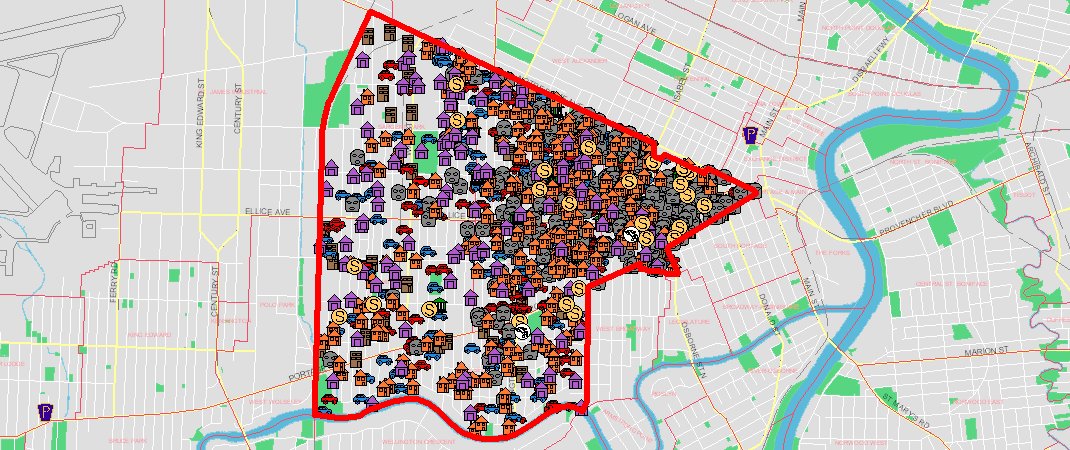
The map below displays reported crime for the ten offenses tracked by Crimestat for the Daniel McIntyre Ward for the period of June 2009 to May 2010

Source:  City of Winnipeg Crimestat website

A Lack of Operational Planning

Through a woeful lack of planning the Mayor and the Chief of Police keep managing to create a sense of urgency on funding police initiatives. First they managed to create a near panic about helicopter funding. Then they attempted to do the same with cadet funding stopping just short of calling the Province deceitful.  I’m starting to get used to the two of them standing together speaking with once voice, joined at the lip so to speak berating the Province. 

It may be time for the province to advise the Mayor and the Chief of Police that a lack of planning on the part of the City and the Police Service does not automatically create an emergency for the province. 

Perhaps its time for the City and the Police Service to put the things they are actually planning to do in the Business Plan and the Captial Budget.  If they did, and  then shared the document with the Province everyone would have a heads up on whats coming.  This would be helpfull for the Province especially as it relates to programs the City wants them to fund. 

An examination of the City’s Departmental Business Plans best exemplifies the City’s  lack of planning.

In 2008 the Police Service created and published its 2008-2010 Business Plan.* That document outlines the goals for the police service for the three-year period, and lists the strategies it will be using to accomplish its goals.

One would think that somewhere in that document one would find a reference to the Closed Circuit Television Cameras the mayor had installed in the downtown area. Surely they could not be funded and installed unless it was a police priority and identified as such in the business plan. Well they were not part of the business plan yet they were purchased and installed. Look up sometime when you are downtown. You’ll see them and even if you don’t, they will “see” you. 

Okay, maybe that one slipped through but surely the helicopter was part of the long-term business plan, or if not part of the business plan then in the capital budget. Wrong! Have a look at the 2008 and 2009 capital budgets. The helicopter does not appear there either.

Surely the reintroduction of the cadet program was part of the business plan. Wrong again!

If none of these initiatives were identified as priorities by the Police Service through the business planning or capital budget process, how did they get on the action agenda? It begs the question: whose agenda is being implemented? Does the agenda reflect the operational needs of the Police Service or the political needs of the Mayor in an election year?

 Perhaps I wrongly concluded at the outset that there was a lack of planning at City Hall and the Public Safety Building. Perhaps there is planning taking place it’s just that it’s political not operational.

*   http://winnipeg.ca/cao/BusinessPlanbySvc.stm

Operational Funding for the Winnipeg Police Helicopter

The following is Clause 1 of the Standing Committee Recommendation which deals with the funding of operating costs for the proposed Winnipeg Police helicopter which was approved by Council in January of 2010. 

That subject to approval of new incremental funding from the Province of Manitoba for all ongoing annual operating costs, estimated at $1.3 million in 2010 plus cost increases thereafter, the Winnipeg Police Service be directed to procure a fully equipped Flight Operations Unit together with a hangar to house the unit.  (Emphasis added is mine) 

Several key words are highlighted.  The first is all.  In his attempt to spin this scenario to  best advantage, the Mayor has talked about being agreeable to limiting increases to an agreed upon formula such as the cost of living or consumer price index.  On the surface that may sound reasonable, however, it only limits increases in expenditures to a percentage above the amount spent in the previous year.  It does not prevent the introduction of new expenditures.  The agreement binds the province to all ongoing annual operating costs.  The province would incur  full liability for expenditures it has no control over. 

This approach can be likened to the ‘we’re talking about less than 40 thousand dollars’ argument.  The mayor is essentially borrowing a line from the used car salesman’s handbook:  it’s the ‘if you are willing to spend $1.3 million, surely you’re not going to let this deal get away for a mere 40 thousand’ line.

The point that can not be ignored is that the province is being asked to enter into uncharted waters.  One question that needs to be asked and answered is, how firm is the estimated operating cost figure?  Why does that become important?  Because, based on the wording of the clause passed by Council, if the estimate is off by a couple of hundred thousand dollars the province will be on the hook for that as well. 

In the context of financial agreements and contracts ALL is a very inclusive term and can be a very expensive word.  And to top it all off, the phrase plus cost increases thereafter leaves the door wide open to additional expenditures that could be billed to the province.   The wording is much to loose.  A very careful, detailed and in depth examination of what is included in the estimate of $1.3 million for operating costs is clearly in order. 

To further bolster his argument, the mayor has pulled out and played the ‘lives are at stake’ card.  The fact is, that can be said about almost everything involving policing.  Police policy and procedure on vehicle pursuits, response to domestic violence, and use of force and a myriad of other issues can also put lives at risk – perhaps much more so than having or not having a helicopter.  But none of those issues are currently on the political radar nor are they likely to the subject of discussion as people cast their ballots in the civic election later this year.  The helicopter, on the other hand, is very much on the political radar.  In a political forum using an argument such as ‘lives are at stake’ can be  successfully employed as a  tactic because it strikes a chord with the public.  It is also difficult, if not impossible, to quantify or to either prove or disprove.  How can anyone argue against a move if failure to make the move could cost lives?  One can only hope that citizens (the electorate) see though this sort of gamesmanship and demand decisions and outcomes based on the merits of the issue versus the use of slick political spin tactics and rhetoric.    

If the city is not confident enough in its estimate of operating expenses to commit itself to a firm funding number they need to go back to the drawing board and rework their estimate.  Further, if they are not confident that the addition of a helicopter will produce at least enough savings to offset inflationary cost increases in the future years, then one might conclude that the rationale behind the entire proposal is flawed.  This is a classic ‘buyer beware’ scenario.  The buyer in this case is the province, which means all of us.

Selling Helicopters Not Naming Rights

In some American cities, city bureaucrats are not selling the naming rights to their police helicopter; instead they are selling the helicopters.   The Colorado Springs Police Department, for example, is selling its two Bell Helicopters for $350,000 each. 

A number of other police departments, including Tulsa Oklahoma, Oakland, San Bernardino and Corona in California, have either grounded or eliminated their helicopter units.   

The reason cited in all the above mentioned cases is budget constraints.   When it comes down to boots on the ground as opposed to an ‘eye in the sky’, these American police agencies are choosing the boots. 

Winnipeg being flush with money, and having fully stocked libraries, no potholes, a fine rapid transit system etc. is bucking the trend.   Up to this point the city has made the purchase of a helicopter contingent on the Province picking up the operating cost estimated to be in the range of a million dollars a year.

Mayor Follows Lastman’s Lead

In 2002 Toronto Mayor Mel Lastman reached out to shake the hand of a member of the Hells Angels, unleashing a fire storm of protest from police officials in Ontario. Gerald Tremblay, the mayor of Montréal at the time who, unlike mayor Lastman, had an understanding and appreciation of what the Hells Angels were all about condemned it as well.    

In Winnipeg this week the publication of a photo showing Winnipeg’s mayor wearing a big grin and posing with former gang members, some with charges still outstanding, didn’t seem to ruffle too many feathers.  

Seven years ago mayor Lastman attempted to deflect criticism by using the ignorance defense, claiming he did not know who the Hells Angels were.  Winnipeg’s mayor employed a similar defense, claiming ignorance of the fact that any of the men he was posing with had outstanding criminal charges.  It worked for Lastman.  Or did it?  

In the Toronto case the mayor’s actions were soundly criticized by then Toronto Police Chief Julian Fantino as well as the head of the police union.  

Mayor Katz probably does not have to worry that his actions will be criticized by the Winnipeg police.  The Mayor is invoking the ‘police made me do it’ line of defense to bolster the ‘I didn’t know’ defense.  According to the mayor the only reason he posed for the picture was because the police asked him to do it.  

Police in Winnipeg say the photo will be helpful in conducting background checks.  Does that suggest that the background checks were not conducted and the personal histories of these people were not known prior to the police service advising or asking the mayor to pose for the picture?  

This would seem to be a situation where either the mayor is receiving bad advice from the ‘experts’, or he is exercising poor judgment in terms of dealing with the advice he is receiving.  Perhaps the so called experts in this instance are also lacking better judgment.  

Enlisting the help of ‘reformed’ gang members to help fight the gang problem is not new to Winnipeg.  Former Chief of Police Dave Cassels got himself in a lot of hot water over the issue.  More recently the Pappiiwak halfway house fiasco illustrated the pitfalls of taking the word of ex gang members at face value.     

When governments are approached by former gang members wanting to initiate gang prevention programs, governments have the upper hand.  These people want something, usually funding.  This puts government in the driver’s seat.    At a very minimum government and the police should: 

  • Check for outstanding warrants;
  • Conduct a criminal record check;
  • Conduct an in-depth background investigation similar to the kind the police do on prospective recruits;
  • Insist that those involved have been pardoned, or at a minimum, have applied for a pardon.   

This is not to suggest that gang prevention strategies cannot or should not involve ‘flying with the crows’.  Flying with the crows, however, comes with its own set of risks.  By taking the appropriate measures up front one can at least be prepared. 

Of prime importance is that governments, when they embark on gang prevention strategies involving ex-criminals, ensure they are indeed ex-criminals.  There must at a minimum be a ‘do no further harm’ guarantee.  There must be a high (very high) probability that those enrolled in such programs will be helped, not further corrupted.

A Helicopter for the Winnipeg Police – Part 4

When I  wrote Part 3 I did not anticipate a need to write a Part 4.  

I wasn’t operating under the naïve assumption that anything anyone said on the issue would reverse a decision that had already been made.  I was confident ‘the cat was already in the bag’.   

I did, however, believe that, as the mayor has a majority on council to support his position, just as a matter of process the $75,000.00 Winnipeg Police Service Helicopter Report would be made available to all the decision makers prior to the vote.  Such a move could have been made to look like a gesture of openness and transparency.  The release of the report, 6 months in the making if it contains all the required information, could have quelled the debate.  It would have answered all those unanswered questions and removed the need to simply ‘trust the experts’.      

So what is the rationale behind the $75,000.00 report being kept under wraps until sometime in the New Year?  Here are two possible scenarios:  

Scenario 1:  That the report is so woefully lacking in terms of addressing the cost/benefit aspect of the helicopter acquisition the mayor would be embarrassed to stake his reputation in support of the helicopter on the document.  The passage of a few weeks or months will ensure that this issue will have moved to the backburner in the minds of most Winnipeggers. When the report is made public most will treat it as old news.     

Number 2.  That the report is woefully incomplete and the additional time period from now until its release will be used to shore up its inadequacies so as to not embarrass the decision makers (i.e. those who had access to the report) in terms of the basis on which they made their decision.     

We may never know the answer or reasoning behind the delay in releasing the report.  If, however, we were in a position to compare the final report when it is released in 2010 to the version of the report the key decision makers no doubt had access to in November of 2009,  the question about the delay in its release might be answered. 

One last point about the decision making process on this issue centers on the council debate of the issue on December 15th.  (I cannot quote from Council Hansard as its publication is 6 weeks behind).  As I understand it, several councilors resorted to emotional and anecdotal arguments in support of their position, specifically, the death of Mr. Zdzislaw Andrzejczak.  The circumstance under which he died  is a tragedy in the first magnitude.  To attempt to insert that tragic situation into the debate without factual basis demonstrates that the councilors in question are perhaps true politicians.  It also exposes flaws in their decision making processes.  

The mayor, behaving a lot like a politician (which he originally claimed he was not), attempted to walk a very fine line on this issue.  On one hand, he agreed with the councilors’ conclusions and then in the next breath, conveniently distanced himself. 

Perhaps it’s time that the debate at the civic level be raised a notch or two.  If the debate contained more facts (what they know) as opposed to supposition (what they think they know) we might all be better off.  One thing is certain, fewer words would be used but the taxpayers would have a better understanding of what is really happening.  

One can only wonder at the questions the other $428 million in capital spending would have raised had it been subjected to closer scrutiny.  Astute parliamentarians have been known to insert red herrings into omnibus bills to divert attention away from the more substantive aspects of a bill.  Was the last minute introduction of the police helicopter a red herring designed to ensure that the remainder of the capital budget slid through the system largely unnoticed like ‘…. though a goose’ as one councilor likes to say?

Will the New PSB Please Step Forward

The New Mega Public Safety Building 

This is the first in a series of articles examining the re-location of police headquarters from 151 Princess Street to 266 Graham Avenue.  This series will take a  look at the expressed operational rationale behind the move and the related costs. 

The Question:  Which building will the Winnipeg Police Service be moving into when they vacate the Public Safety Building?   

A)  The Winnipeg Post Office office tower at 266 Graham,    

                                                    OR

B)  The Winnipeg Mail Processing Plant, (WMPP) illustrated in the photo below?

The Answer:  B, the Mail Prosessing Plant

There is a lot of buzz in Winnipeg these days, especially in the police community, about what has been dubbed as the new ‘Mega PSB’.  The $135 million plan recently approved by council will see police moving out of its current headquarters, the Public Safety Building at 151 Princess Street, by 2013. 

Which space are they actually moving into?  If your impression is that it will be the office tower facing Graham Avenue, featured on the City of Winnipeg website as the new headquaters, then you have the wrong impression.  In this case what you see is not what you get.  * (See web link below)  You can’t be blamed entirely, though.  The mayor and the city spin doctors (another example of your tax dollars at work) have done a nice job of spinning this one.   

The portion of the property that the police are actually getting is the old Winnipeg Mail Processing Plant – the dumpy, or shall we say, squat, four-storey structure at the south end of the property and not the impressive office tower that has been so prominently featured in the media.  (Of course, once you put that brand spanking-new shooting range on top, it might not look so squat.)  The public seems to have concluded, almost unanimously, that the police were moving into the office tower.  But even with the best spin it is difficult to fool all of the people all of the time. 

In fairness the report prepared for Council when carefully read implies that the police won’t be getting the office tower.   As is so often the case, interpretation becomes important and the devil is truly in the details. **  In this instance, the ‘details’ reveal that  the portion of the property being redeveloped is limited to the Winnipeg Mail Processing Plant and does not include the office tower which served as the backdrop for the ‘turning over the key/early Christmas present ceremony’ orchestrated by the City.  The office tower portion of the property, it turns out, is tied up in existing leases and options and will not likely be available for police use for the next 15 years

The current plan calls for the city to develop approximately half a million square feet of space for police use at a cost of $135 million:  $30 million to purchase the building and another $105 million to do the upgrades.  There are some important unanswered questions hanging in the air.  Anyone who has restored an old building, or watched This Old House knows that when you revive old buildings they can become money pits. Does buying and restoring a 55 year old building to replace a 45 year old building (PSB), the interior of which has been recently and extensively upgraded, make good sense from a practical business perspective?   Were other options considered?  Can this project be brought in on budget or is there a risk that this project will become a public money pit with Winnipeg taxpayers footing bill? 

Frankly, a more thorough examination of the monetary and non-monetary reasons put forward by the Police Service and the Property and Development Department in support of this proposal is needed.  Is the space being redeveloped adequate to house all Divisions, Units, and services being proposed for relocation to the site?  Is relocation of units such as the Professional Standards Unit within the confines of a police station appropriate?  Are the operational advantages and savings cited in the report real or are they empty words used to prop up the proposal and make it easier for decision makers to arrive at the ‘right’ decision?   

Those issues and questions as well as others will be examined in future posts.

In the meantime, a quick memo to Sponsor Winnipeg:  Now that the City owns the building at 266 Graham, best to put it on the naming block, and consider removing the Winnipeg Square Parkade in light of the fact that the City has already paid someone $400,000 in commissions to sell that particular property.

* Image of Post Office Tower from the City of Winnipeg website at:

http://winnipeg.ca/interhom/headquarters.stm

** Complete report on the City acquisition of the property at 266 Graham Avenue is available at:

http://winnipeg.ca/clkdmis/ViewDoc.asp?DocId=9721&SectionId=&InitUrl=

Peel’s Ninth Principle

Principle Nine

 To recognize always that the test of police efficiency is the absence of crime and disorder, and not the visible evidence of police action in dealing with them.

In 1829 the word ‘efficiency’ had a broader meaning in the context of measuring organizational performance than it does now.  As performance measurement has progressed, organizational performance measurement has been divided into two distinct areas, efficiency measurement and effectiveness measurement.  In 1829 the term efficiency essentially embodied the meaning of both those terms.  As the word is used in the Ninth Principle it embodies both the concept of delivering a service at a reasonable price, and delivering a service that has the desired outcomes.

This principle is one of the first to express the need to test or measure  police performance.  It essentially says the emphasis should be on outcomes as opposed to outputs.  In this context the desired outcome is the absence of crime and disorder, the outputs are the actions undertaken by police to achieve the outcome.         

Efficiency is measured in terms of cost, i.e. are tax payers receiving good value for their tax dollars?  In the policing context cost is examined at various levels.  At the highest level cost would be looked at as the per capita cost of policing.  The per capita cost of policing in Winnipeg according to the Winnipeg Police 2008 Annual Report was $259.40.* Cost can also be calculated on a per-unit of service basis.  As an example, the cost of issuing a photo radar ticket in Winnipeg was reported to cost $48.01 in  2004. **  Once established, cost figures can then be compared to costs reported by other police agencies to determine a relative level of efficiency. 

Establishing whether the organization is effective is more difficult and involves an examination of whether the organization is doing the right things to achieve its stated goals.  Most police agencies have a stated or at least implied goal of reducing crime and disorder. Effectiveness measures establish whether the strategies, approaches and tactics employed result in the desired outcomes.  In Winnipeg, as an example, the Police have employed an innovative strategy to address the auto theft issue.  The stated goal was to reduce auto- theft.  With reductions of 16, 37 and 43 percent between 2006 and 2008 the strategy can be judged to be effective. *   The desired outcome was realized.

Many public service delivery organizations (both policing and non police) have become overly politicized.  In the case of municipal policing, police departments can become extensions of their political masters – especially if there are no effective buffers between the police and the mayor.  This is most clearly demonstrated in the United States where the links between municipal policing and mayors is closer than in Canada.  In the United States the mayor’s agenda frequently becomes the police agenda.  In some major American cities the position of Chief of Police is essentially a political appointment.  Many mayors in large American cities run on law and order platforms and one of the first things they do when elected is to appoint a new police chief whose approach and values are in keeping with their own.  Miami and Atlanta are recent examples of this phenomenon.

The more politicized an agency becomes the greater the emphasis on activities, or in Peel’s words, “visible evidence of police action”.  The emphasis on action allows both the politicians and the police to be seen to be doing something.  The emphasis on action can detract from a close examination of the services being delivered.  Program evaluation is mandatory to determine if the actions undertaken are yielding the desired results in terms of outcomes. The action orientation tends to discourage evaluation. 

Daily news conferences held by police agencies are intended to inform the public through the media of crime that is currently occurring in the community and, of course, what the police are doing about it (actions).  News conferences are not the forum in which to discuss outcomes. 

Reporting to the public on outcomes is more appropriate in an annual report.   Most police agencies, however, give limited coverage to reporting on outcomes in their annual reports choosing instead to highlight activities.  It is the statistical portion of the annual report that tells the real story about police efficiency and effectiveness, not the pictures and stories.  Statistical reporting, however, accounts for only 10% (in terms of volume) of most police agency annual reports. 

Some progressive police departments actually publish meaningful business and strategic plans that outline in detail police priorities and goals for the next 1-3 years.  The degree of goal achievement is reported upon in subsequent years and in some cases during the course of the current year.  Generally the goals relate to crime reduction or the restoration of order in the community and reflect an attempt by police to deliver services and measure their outputs and outcomes in keeping with this principle as opposed to simply reporting on their activities.    

In order to achieve outcomes police agencies need to state their goals and objectives up front and then report on their progress.  This needs to become part of the public accountability process.  In order for police to establish widespread public support they need to be accountable to the public. 

The Vancouver Police Department publishes an Annual Business Plan which lists both its goals and the strategies that will be employed to achieve the goals. ***  It serves as a good example for police agencies that do not formulate or publish meaningful business or strategic plans. 

*Winnipeg Police 2008 Annual Report.  Available at   http://www.winnipeg.ca/police/annualreports/2008/2008_WPS_Annual_Report_English.pdf

** City of Winnipeg Photo Radar Audit.  Available at  http://www.thenewspaper.com/rlc/docs/2006/winnipegaudit.pdf

*** Vancouver Police Department, 2009 Annual Business Plan.  Available at http://vancouver.ca/police/policeboard/agenda/2009/090121/8VPD2009BusPlan.pdf