Just Answer the Question, Sam

When I read Bartley Kives’ interview with Mayor Sam Katz in today’s Winnipeg Free Press where Kives asked the mayor about the murders in the north end, two things came to mind: firstly,  the answer does not fit the question, and secondly, in the words of Shakespeare, he  “doth protest too much, methinks”.

It is not unusual for politicians to avoid answering questions put to them by the media.

What is unusual (and curious) is when  politicians offer up information that although not relevant to the question invites all kinds of other questions while revealing  their insecurities and self doubt about the things they are doing.

In his year end interview with the Mayor, Bartley Kives asked the Mayor a simple question:  FP: How do you feel about the unsolved triple shooting at the end of October?”

The Mayor’s reply was It was not a good day in the City of Winnipeg, I’ll be blunt with you. I assume (the police) are still doing their investigation and will come up with information and hopefully solve it. For all I know, they could have suspects as we speak. But I don’t know, because I don’t interfere with police investigations. I have never done it before and I have no intention of doing it right now.”

Let’s analyze the part about the shootings not being “…a good day in the City of Winnipeg…”

He seems more concerned with the overall image of the city, but is this the time to be worrying about it in this context?!  What kind of day do you think it was for the 3 people who were shot?  What kind of a day to you think it was for their relatives, friends and neighbours?  What kind of day do you think it was and still is for the neighbourhood where the random shootings took place when they are advised by police that they couldn’t protect them and they should stay in their houses?

When you look at the Crimestat map depicting homicides, shootings, muggings and sexual assaults in a few of Winnipeg’s north end communities, it’s readily obvious that it’s been awhile since those communities have had a “good day in the City of Winnipeg”.
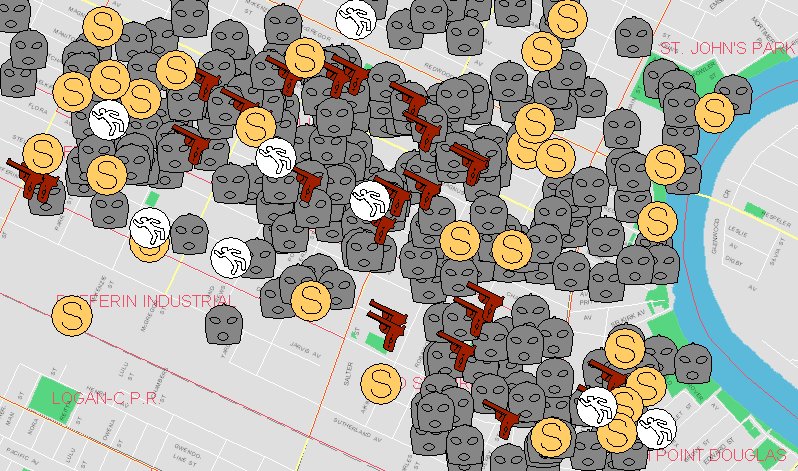
Winnipeg Police Crimestat (depicting homicides, shootings. muggings and sexual assaults  between January 1st 2010 and December 27 2010)

The mayor went on to say “I assume (the police) are still doing their investigation and will come up with information and hopefully solve it. For all I know, they could have suspects as we speak.”

Unless the mayor is not reading the briefing notes he is sent (or dozing off during his weekly briefings with the chief of police), there is no need for him to make any such assumptions on the progress of an ongoing investigation. To suggest he is taking a disinterested ‘hands off approach’ in terms of the progress of this investigation means he is either a fool or he is negligent.  Politicians need to keep themselves informed and abreast of what is happening.  To pretend otherwise is cause for concern.  The mayor can and should be kept informed about the progress in an investigation of this magnitude and it can be accomplished without piercing the ‘sacred veil’ of police operations.

Lastly, the Mayor says:  “But I don’t know, because I don’t interfere with police investigations. I have never done it before and I have no intention of doing it right now.”

Where is this comment coming from?  Where in the interview is it suggested that he has or may be interfering with police investigations? Why the unsolicited denial?  Even the layperson knows that there is a big difference between being briefed and being kept aware of the progress of police investigations, and interfering in them.  Politicians should keep themselves informed, and they must not yield to the temptation to interfere.

The mayor then qualifies his statement further by saying he has never done it (it being, interfering with police investigations) and that he has no intention of doing it right now.  Never is a pretty strong word. All inclusive, leaves little wiggle room, little room for interpretation. Never means never. Not even once.

The mayor says he will not interfere with the ongoing police investigation “right now.”  Does that mean he is reserving the right to interfere in this or other police investigations in the future?

Election Promises: Part I

During the recent election campaign Sam Katz made a number of promises ranging from pop bottle recycling, additional monies for community centers, and of course, more money for policing.

This will be the first in a series of posts that will examine the policing/community safety commitments made by the mayor during the 2010 election campaign, those being:  the addition of  20 officers for beat patrol; 18 officers for general patrol;  20 officers for a gang unit; and 19 civilian positions for the 911 call center.

Subsequent posts in this series will provide some history in terms of police initiatives and practices as they relate to foot patrols, general patrol and the gang unit.

Putting Additional Officers on the Street

Screening, hiring, training and putting police officers on the street is a long and arduous task.  The majority of the 58 additional police officers promised by the mayor will not be fully trained and ready for street duty until  late 2011 or early 2012.  The next Recruit Training Class is not slated to start until August of 2011, just 2 months prior to the next provincial election.

In light of the fact that the Police Service has more than a year of lead time, they  have an opportunity to give some serious thought to the assignment, priorities and job descriptions for these additional officers.  That’s assuming that the decision as to their deployment will be based on operational needs as opposed to political whims.  Should the gang unit be launched  first, or should the foot patrol officers or the additional general patrol officers take precedence?  Only the Service (or the mayor) will answer those questions.

The decision, whatever it is, will signal whether the Service is going to stay the course in terms of using a largely reactive approach or whether they are ready to embark on a more proactive approach to dealing with crime in this city.

Part II will start by examining the Winnipeg Foot Patrol experience from around 1970 onward and provide backdrop for the decision-making process concerning the assignment of the new foot patrol positions.

Starlight Tours in Winnipeg Part II

The Evan Maud Case

The taking of a statement and the questioning of a complaint are usually the first steps in the initiation of an investigation, any investigation.

When Evan Maud publicly alleged that members of the Winnipeg Police Service took him on a “Starlight Tour” police were naturally anxious to speak to him.  The reputation of at least two particular officers and in a general sense the reputation of the entire organization was at stake.

So how does this type of investigation unfold?

Firstly, investigators when taking a statement and questioning a complainant must take pains to ensure that all facts possible are obtained from a complainant at the outset.  If an investigation is initiated based on limited or incomplete information and the investigation subsequently reveals inconsistencies the complainant is in a position to modify or add to his/her version of events based on what investigators have unearthed.

Once all facts have been obtained the next step in the investigation is to test the veracity of the complainant’s statement.

This is done by gathering evidence.  Evidence will either confirm or refute what the complainant has said in their statement.  In the Maud case possible sources of evidence would have been:

  • The Winnipeg Police calls for service and officer initiated contacts database
  • The Winnipeg Police vehicle GPS database
  • Winnipeg Transit on board video database
  • Private surveillance video from locations where the compliant indicated he had been prior to during and after the time in question
  • The statements of witnesses the complainant indicated he had contact with

Of course only the investigators  privy to Maud’s complaint  have knowledge of all the evidence sources that needed to be exhausted, based on the content of the statement.

Usually when a complainant makes a statement there are at least one of two facts included that will cause experienced investigators to sit up and take note.  There is usually something that the complainant says, that based on the investigators knowledge and experience just does not make sense.

It is often an inconsistent comment made by a complainant that focuses the direction of the investigation during the initial stages.

When I read the media accounts of this incident, the assertion by Maud that police took away his jacket and substituted a sweater was one such statement.  It just did not make any sense and suggested an alternative explanation that accounted for the complaint’s jacket perhaps being missing.

Based on the fact that Evan Maud has been charged with public mischief the evidence to support the charge must be overwhelming as in most jurisdictions charges of public mischief in cases of alleged police misconduct require crown approval before being laid.

The  Winnipeg Police news conference after Maud had been charged was revealing.  Police released a lot of detailed information in terms of evidence that had been gathered to support the charge against Maud.  Much more information than would normally be released in relation to a matter before the courts.

I understand why they did it in terms of supporting their position to charge Maud, but it may have set a precedent in terms of the information the media will demand in relation to other cases in the future.  Much of the information released  had it been asked for in any other case would  had resulted in a “we cannot comment on that as the matter is before the courts” comment.

I was also gratified to see Grand Chief Evans at the new conference.  I’m confident he would not have taken the position he took unless the Winnipeg Police Service shared the full details of the investigation with him.  It took a lot of courage for Grand Chief Evans to take the position he took on this issue.

Grand Chief Evan’s quote reported in the media definitely qualified as the quote of the day.  Grand Chief Evans said:  “I have to stand with the truth, sometimes the truth can take you to very difficult places.”

I’m very pleased this investigation was conducted expeditiously.  Had it been allowed to drag on and hang in the air for months like the Cody Bousquet investigation it would have had the potential to cause great harm to the reputation of the police service and its members.

In this case the Service came out of this with its reputation entact.

By the way, how is the Cody Bousquet investigation coming?

How To Not Get Your Ass Kicked by the Police

Well known comedian Chris Rock performed a  public service when he put out the video that outlines in a humorous manner how to “avoid getting your ass kicked by the police”.

Although based on the American experience, most of Rock’s ‘hints’ are as applicable in Winnipeg as anywhere else. Following  these common sense  suggestions might save you time and aggravation if you were to have an encounter with the police.

Hint #1  Obey the law

Most law abiding citizens have fewer  negative encounters with police than those who break the law.  Most people have a pretty good idea as to what is and is not legal.  If you don’t,  find out what the law is (in most cases a quick Google search will tell you) and obey it.  That way in the event you are stopped you know what the outcome is going to be.  You will be leaving on your own and end up at home as opposed to the Remand Center courtesy of  a black and white taxi.

Hint #2   Stop Immediately

If the police are attempting to pull you over they usually have a reason for doing so.  Perhaps you violated the Highway Traffic Act or you (and/or your vehicle) match the description of a person or vehicle wanted for a crime recently committed, or you are riding in a stolen car.  Once you see the flashing lights – stop.  Your encounter with police will be less traumatic it they don’t have to chase you down.

Hint #3 Be Polite

Most police officers, when they stop you, will be polite.  Be polite in return.  Do not give the police a reason to not be polite.  If your car is bouncing up and down with the music, take Chris Rock’s advice and ‘turn that shit off’.  If you are asked for your drivers license and registration (which police are entitled to do if you are driving a car), produce them.

Hint #4  If stopped stay in your car with your hands visible

With the number of illegal weapons (guns, tasers, peppers spray) on the street, police have a legitimate concern for their safety when they stop you either as a pedestrian or driving a vehicle.  If the police pull you over while driving your vehicle stay in the vehicle and keep your hands where police can see them.  Don’t be reaching under the seat or your glove box as police walk up to your vehicle.  They may think (and legitimately so) that you are reaching for a weapon.  Stay in the car until police ask you to get out.  If you are stopped as a pedestrian, don’t reach into your pockets, or inside your coat.  If police want you to pull out your identification, they will ask you.

Hint #5  Respond to questions when asked and avoid being verbally abusive

Most times when you are stepped by police they will advise you why they stopped you.  If they don’t, politely ask them for the reason.  Yelling and screaming at police during the first stages of a stop will not work in your favour.  If police are going to ‘detain’ you even for a short period of time, be aware that every citizen has the right under Section 10 of the Charter of Right and Freedoms to being informed of the reason for the detention.  So if you are not told up front, ask –  politely.

Hint #6  Be aware of what passengers in your car have on them

If you are going to give someone a ride and you know that they usually carry a gun, drugs,  other contra ban such as stolen goods or have outstanding warrants for their arrest, you are asking for trouble.  If the police see such a person in your car you will be stopped and the stop may well be treated as a high risk take down so you and your passenger(s) may find yourselves out of the car quickly and spread eagled on the street without a lot of questions being asked.  If you don’t want that have your friend take a taxi or a bus.

Watch the video.  Chris Rock says it so well  and he’s so right.

How To Not Get Your Ass Kicked By The Police

The New Winnipeg Stadium – The Real Cost to Tax Payers

The Mayor is quoted as saying that for an investment of only 6% of the overall cost of $190 million, Winnipegers are getting a new stadium.

That 6% is made up of 10 million dollars in outright grants from the city, and 1.6 million dollars in new infrastructure requirements at the new stadium site.

That’s 11.6 million dollars.

A further 1.1 million dollars in the form of  ‘in kind’ services for building and development permit fees is thrown in as a freebie.

The Mayor is right.  If the $1.1 million in in-kind services is ignored, the $11.6 million works out to approximately 6 % of the overall 190 million dollar estimated cost of the new stadium.

Now if that were the real cost to Winnipeg tax-payer, that would be a good deal.

However, the Mayor (as he frequently does) is telling only a portion of the story.

The City is on the hook for a further  75- 85  million dollars (depending on which numbers you look at) which will be repaid using tax dollars generated through the Tax Increment Financing scheme once the site of the current Winnipeg Stadium is sold and redeveloped.

Because this is new money,  the mayor has conveniently chosen to ignore it.  If this additional money (cost) is factored into the City’s contribution to the stadium project, the total cost to Winnipeg tax payers is in the range of  87 million dollars.

That ups the City’s percentage contribution to the project from 6% to 46%.

In the words of Brian Kelcey,  a former advisor to Mayor Katz, the mayor and councilors need to remember that:

“Just because it’s new money, doesn’t mean it isn’t real money”

Taking into account the true cost to Winnipeg tax payers, is this still a great deal?

Tax Increment Financing

What is Tax Increment Financing (TIF)

Let’s look at it this way.  There is a piece of  property that is generating minimal tax revenue.  If that property were developed and turned into, say, a shopping mall, the newly developed property would yield significant tax revenues.  The upfront costs of the development are high and require borrowing.  In order to pay back the borrowed money, the ‘tax increment’ (that being the difference between the amount of taxes collected prior to and after the development takes place) is designated to pay back the loan incurred to fund the development.

A simplistic depiction might look like this:

  • Current taxes collected on the property    $100
  • Development costs  $100,000
  • Post development taxes $10,000
  • Tax increment $10,000 – 100 = $9900
  • For the first 10-15 years post development the city would use the tax increment ($9900) to pay back the development loan
  • Once the loan is paid off, the taxes generated from the development would return to the city’s general revenue stream

History of  Tax Increment Financing (TIF)


Although relatively new in Canada and especially Manitoba, TIF has been used in the United States for almost 60 years.  In Manitoba the government introduced a bill in 2008 which led to the enactment of the Community Revitalization Tax Increment Financing Act in 2009.

In a 2008  news release when the legislation was announced, the government indicated:

“Our priorities for TIF include support for the further development of Winnipeg’s  inland port, rapid transit system, as well as affordable housing in downtown Winnipeg”.

The government further stated:

Money collected from a community revitalization property would then be invested only in the same designated area”.

The press release concluded by saying:

Tax increment financing is used in several American cities to support revitalization and renewal initiatives.  In Manitoba these levies would be used to support economic development, community revitalization such as housing, social and cultural development and heritage preservation”.

The minister of the day also stated:

It is our intent to consult with and report on the use of tax increment financing to ensure full accountability and support for our priorities”.

The Community Revitalization Tax Increment Financing Act was passed in 2009.

General Assessment of Tax Increment Financing


In the United States TIF has been widely used as a tool to spur economic development in depressed areas.  The general conclusion seems to be that if properly used, TIF can be a valuable tool.

There have been some general criticisms about TIF schemes.  They include:

  • designation of areas as TIF designated areas that would have been developed in any event even without designation;
  • favouritism and special advantage for developers who are politically well-connected; and
  • tax payers bearing the cost of additional public services needed to service the newly developed property.

As an early  attempt at TIF, the Stadium Project, does not seem to fall in line with the stated goals and priorities announced in 2008 prior to the introduction of the legislation.

The tax increment ‘generated’ in the downtown area is being ‘spent’ in the south end of the city- not to develop an inland port, not to support rapid transit, not to create housing in the downtown.  No, instead its being used to build a new stadium at the University of Manitoba.

The Benefits of Openness and Transparency in Policing

One of the keys to the development of positive relations between the police and the community is the creation of a culture of openness and transparency in policing.

During my many years as a police officer I found that when police explain what they are doing and why they are doing it, all but a few members of the public (and the media) ‘get it’. They may not always agree but they recognize and understand the rationale.

What is required from police is a willingness to be open and transparent. Police departments have been and continue to be secretive about almost everything they are involved in. Unless, of course, they are looking for media coverage of positive stories or they need media assistance in getting out a message about a particular case where they need information from the public to solve the case.

Greater openness and transparency on the part of police departments would go a long way to improve the police image in the eyes of the public. It would also provide a greater measure of accountability.

Lets look at an example: there are few issues in policing that create more heated debate than police use of force. Police departments are seldom taken to task for high crime rates, low clearance rates or the like. But, an instance of police use of force, especially if captured on video (such as the Rodney King incident in Los Angles, the Robert Dziekanski incident in Vancouver or the Cody Bousquet case here in Winnipeg) focuses public attention on the actions of police.

One of the main issues when these types of incidents come to the public’s attention is that the public, and to a lesser extent the media, are ill-informed about what police department policies are in relation to use of force.

There are several approaches that can be taken to address  issues like this in a proactive way. One is to create greater transparency in terms of police policies and procedures. If, for example, both the public and the media are fully aware of the police department’s use of force policy, and the policy is a public document, a lot of speculation and misinformation could be avoided.

Secondly, if police departments conducted information sessions explaining their policies both for the media and the public, the resulting dialogue would eliminate many of the misconceptions that exist.

Some police departments such as Vancouver and Portland, Oregon have put their procedure manual on-line – a bold and progressive step.

Police in Oakland, California recently invited the community and the media to a seminar that outlined the use of force training received by members of the Oakland Police Department. The seminar dealt with both the legal use of force framework, as well as hands on demonstration of video simulator training.

Initiatives such as these reinforce openness, transparency and accountability to the public on the part of police and create positive dialogue between the public and the police.

Note: The Oakland Police Department has also opened its CompStat meetings to the public.

Stadium Funding Debate Sparks “Gun-play”

Who is really being childish here?

In a move described by Councillor Russ Wyatt as “having a gun stuck to your head”, the Mayor attempted to ‘walk’ stadium funding onto the city council agenda.  Such a move requires a suspension of the rules.  Wyatt and five other councillors decided not to simply roll over on the issue and notified the Speaker they would not support a suspension of the rules.

This left the Mayor with two options:  put the issue on the agenda for the next council meeting, or call a special meeting.

Councillor Justin Swandel has characterized the move by Councillor Wyatt and the other councillors as a childish stunt.

This prompts questions:

If the exercise of their rights by councillors is viewed as a stunt, then why not change the rules so that the Mayor and Councillor Swandel can walk anything onto the agenda at any time?

Why do the Mayor and Councillor Swandel view this attempt to promote transparency and accountability for public spending as a negative?

Has the obvious lack of due diligence, cost guesstimates and flawed decision-making not already created a large enough mess?  The big hole in the ground at the University of Manitoba says that it has.

Is it not time that someone actually sat down and gave this entire project some sober second thought without rushing it through?

Some of the techniques being employed by the Mayor are very similar to those used by  scam artists: create a sense of urgency, rush the decision, decide right now because time is of the essence, act right now or the price will go up.   Never mind providing the required information to allow proper study and evaluation – just trust me and you can’t tell anyone else about this.   Sound familiar?  It seems the public was already scammed once on the stadium deal.  Should we throw good money after bad money?

Exercising his rights, the Mayor called a special meeting of City Council (not to be confused with a childish stunt) and pushed stadium funding through.    The mayor and his buddies got their way, just a day late.

Due process must be such a downer – especially for politicians with dictatorial tendencies.


Starlight Tours In Winnipeg

Myth or reality

The recent allegations by Evan Maud that he was picked up by police and driven to the outskirts of Winnipeg, deprived of some of his clothing, threatened with a Taser and then abandoned, have the potential of setting back relations between the Winnipeg police and the Aboriginal community all the way to the J. J. Harper era.

Since the incidents of police in Saskatoon driving young aboriginal males outside the city and abandoning them first came to light, there have been on going rumours about the same thing having happened in Winnipeg.

When aboriginal people say to each other or their leaders ‘that happened to me’ but fail to come forward and file a formal complaint, they perpetuate what is either a myth or a very serious problem.  If if did not happen, then the Winnipeg Police Service and its members are  being maligned; if it did happen, heads should roll.

I have only one word of advice for Evan Maud his family, and the aboriginal leaders who are advising him:  Make a formal report and do it now. And I don’t want to hear any nonsense about not trusting the police or the process.  In a high-profile case such as this, if the matter is reported it will be properly investigated.

If the matter is submitted for investigation there are basically three possible outcomes:  Either Maud was picked up by Winnipeg Police officers; picked up by men posing as Winnipeg police officers; or, it did not happen.

Either way the matter needs to be investigated, and  appropriate action needs to follow.

The “Reactive” Councillor Steeves

Politicians see themselves as leaders not followers.  They tend to portray themselves as proactive not reactive.

Yet at times during periods of extreme political euphoria such as the recent political spin fest centered around the unveiling of the Winnipeg Police Helicopter,  politicians at times develop loose lip syndrome.

Loose lip syndrome usually occurs  when politicians stray from their prepared script and say what they actually think or believe.

At the recent Winnipeg Police helicopter unveiling where politicians attempted to out gush each other and  convince themselves, each other and the unwashed masses who pay the bills that  they are spending tax dollars wisely, Councillor Steeves made a fatal slip of the lip displaying his true colours when he said:

“The announcement today is going to give the Winnipeg Police Service an increased ability to react.

Yes, React!

If the best we can expect from a 3.5 million dollar capital expenditure coupled with 1.3 million dollars annually is a better reaction perhaps it might have been beneficial to examine the expenditure more closely and consider other options that  had a realistic chance of preventing crime.