Oh What Tangled Webs We Weave….

…when first we practice to  deceive (or  raise the frontage levy)

When not raising property taxes becomes a dogma,  common sense tends to become a rare commodity and politics take over.

If property taxes alone don’t yield enough revenue to pay the bills, but you doggedly stick to the idea of not raising property taxes – something has to give.  What are the options?  The options include raising existing levies (such as the frontage levy), raising or adding  user fees (at libraries,  or swimming pools), or reducing services (arenas).

Picture this:  let’s say the owner of a sports franchise  (for the sake of argument, the Goldeyes) doesn’t want to raise  ticket prices but  still wants to increase revenues.

How can you increase revenue without raising ticket prices?  The answer seems to lie in adding surcharges for the little things that patrons rely on in order to enjoy the experience.   You could charge for vehicle parking.  When patrons walk in the door you raise the price of printed event  programs.  Raise the price of the food and drinks at concessions. Patrons will need to use the washroom, so add a user fee.  You see where this is going.  There are all kinds of things that can be done to raise additional revenue without raising ticket prices.

In other words there are many ways that patrons can be ‘Sammed’.

This is what seems to be happening at city hall.  Councillor Russ Wyatt has brought forward several more examples of how we are being Sammed. According to Wyatt:

In 2007, after much public criticism, the Mayor ended the practice of ‘transfers’ from the water and waste utility of the city into the General Revenue Fund (in other words sewer and water rates were being used to balance the budget).  The Mayor at that time agreed, and likened the practice to the Province raiding Hydro revenues to balance their budget. So he ended the policy.

Now he is attempting to unearth and resurrect the same policy, except he is calling it a ‘dividend’ and not a ‘transfer’.  Don’t be fooled, as it means the same, and confirms that Winnipeger’s are obviously paying too much for their sewer and water rates, now the highest in Canada!

Today this tax/rate grab is equal to $17 million.  The wonders of an 8% dividend policy is that as the water and sewer rates continue to rise (as they are projected to do so), so does the tax/rate grab.

What is even more interesting is that this would never be allowed outside the City of Winnipeg.  Outside the city, municipalities are subject to a little thing called the Public Utilities Board. The PUB would never allow such a rate grab, indeed, they would demand such revenues to be returned to the customer.

At the time of the new Water and Sewer Utility debate, there was great internal discussion of making the utility subject to the PUB.  The issue of loss of control killed this idea.  We now see the benefits to balancing the budget at the expense of w and s rate payers.

Councillor Wyatt then goes on to summarize the impact in terms of the additional revenue flowing into the city and the impact on taxpayers.  He puts it this way:

What does all this mean to the bottom line for tax payers.  The Frontage Levy increase brings in $14 million (and no new money to roads), the dramatic increase in Rec fees hauls in $1 million more (which helps the city ‘market’ out their arenas, now that the Chair of Finance has said Parks and Recreation are NOT a core municipal service–Giving Wpg a monopoly on wisdom compared to every other city in North America), and $17 million more from the Water and Sewer Dividend.

The total is $32 million, or the equivalent of an 8 % Property Tax Increase. Now, I have been the strong advocate over the last few years of a modest tax increase in our budgets.  However eight percent is actually eight times higher than the latest Consumer Price Index for Winnipeg which was projected recently at 0.8%.

I believe these latest developments vindicates my position, as now Winnipeger’s are facing this massive rate/tax/levy increase all at once.  And why?  Last year the Mayor included tens of millions of ‘one time’ money just so he could balance his budget and get past the Civic General Election. Furthermore he continues, without any sense of reason or rational debate, to perpetuate the property tax freeze, now in its 14th year.

I think the Councillor from Transcona has a point!

Increase in the Frontage Levy: Are we being “Sammed”?

Question:  If the government (at any level) passes legislation that requires citizens to pay  money to government  and the people have no choice but to pay it or face consequences, what is that called?

Answer: A tax.

Question:  So when the government passes legislation to increase the amount we already pay, what is that called?

Answer:  A tax increase.

The increase in the frontage levy means we just got “Sammed”.  What is the differenced between being Sammed and being scammed? Just the letter “C”.

His Worship is up to it again. During the election campaign he mocked and ridiculed the idea of increasing taxes.  He suggested that a tax increase of 20-30 dollars per property would cause some Winnipeggers to have to give up their homes.

Did the economic condition for the average Winnipeg homeowner change dramatically in the past 6 months?   It must have because His Worship now thinks that homeowners can absorb a much greater increase and presumably not lose their homes.

Does it really matter what you call it or what the money is intended to be used for?  If it’s money that flows to government, and citizens have to pay, it is a tax by another name.

I’m sure the owner of a small older bungalow on a property with a 50 or 60 foot  frontage, valued at 200 thousand dollars won’t mind that they will be paying more than the owner of a 400 thousand dollar home in a new development built on a narrow lot.  I’m sure they will see that as their civic duty.  Not!

Yes, I believe we just got Sammed – again.

The Effect of Adding 18 Positions to General Patrol

Of the additional 58 police positions promised by the mayor as part of his re-election platform, 18  are destined for General Patrol, commonly referred to within the Service as GP.  GP officers are the uniformed officers assigned to work marked patrol units.  When citizens call 986-6222 or 911,  GP officers are the ones who respond to their calls for service.

Media reports have indicated that the 18 positions being added to GP will produce “another shift” .  The implication of that is rather misleading but up to this point I have not heard either politicians or the Police Service saying anything to correct the misconception or explain the actual effect of adding 18 officers.

Here’s how it works:

The Police Service currently fields a minimum of 27 2-officer patrol units at the start of each shift, 365 days a year.  This means that the day shift starts with 27 units, as does evening shift and midnight shift.  The reason the term ‘minimum’ is used relates directly back to the wording in the Collective Agreement between the Winnipeg Police Service and the City. The minimum number of units the Police Service puts out on the street  forms part of the collective agreement.  The Service can field more than 27 units if personnel are available but it cannot field less.   Starting a shift with less than 27 2-officer units would violate the collective agreement.

So, how many police officers does it take to field one additional 2-officer unit?  The answer is 18.

The 18:1 ratio

Prior to the mid-1990’s the Police Service used a rather loose calculation to determine how many officers were required to field one unit 365 days a year.   The commonly used ratio was in the 14:1 range with an allowance for additional personnel in Divisions 11 (downtown) and 13 (north-end), based on workload.  The problem identified by Uniform Division Commanders operating under the 14:1 ratio was that  they could not field the required number of patrol units unless they drew resources from other areas such as Traffic, Community Constables,   plain clothes units  or called out off duty personnel at overtime rates.

Around 1995 a couple  of newly promoted Superintendents decided to have a look at the ratio being used. This review resulted in a report being submitted to the Executive of the day  recommending that the ratio be changed to 18:1, which it was.

That perhaps makes it easier to understand why the Mayor picked the number 18.

Eighteen additional GP officers translates into 1 additional  patrol unit.

That’s 1 additional unit, not “another shift”.

In a future post I will examine why it takes 18 officers to staff one patrol unit.

Fantasy Island

Remember Fantasy Island?

Tattoo:  “Look boss, de plane, de plane!”

Mr. Roarke:  “No Tattoo, that is not de plane.  That is de Winnipeg Police Helicopter.”

The Winnipeg Police Helicopter,  we are told,  is now operational.

The on time criteria has not been met as it is about 5 months behind schedule.   No word yet as to whether it is on budget.

However, step aside, all ye naysayers:  the Police Service has come up with yet another potential use for the helicopter.

When it is not busy  rescuing elderly confused males lost in the Assiniboine Park Forest, it will be used to fight the anticipated 2011 flood.  Will it be used to deliver sand bags?  No, it is too small for that.  Will it be used to pluck people from the rooftops of their houses?  No, it’s not equipped for that.

What will it do during the flood?

Seeing as it is jointly funded by the city and the province, it could be used to take the mayor and the premier on “rides” so they could view the devastation from topside.  I’m not sure what the protocol is in terms of who has first dibs – the city because it bought the helicopter; or, the province because it pays for the pilot and the fuel.  But I’m sure they will work that out.

In any event, can you visualize this:  the Winnipeg Police helicopter, just a speck in the sky, approaches the flood-way gates where a throng of reporters are waiting.  The helicopter lands, and the mayor and/or the premier get out quickly before the rotor blades stop turning (this allows their hair to get messed so they look like action heroes).  They greet everyone, thank them for coming and launch into a speech describing the great things they are doing to protect Manitobans from devastation.  Then,  quickly back into the helicopter to save us from something else.

Great photo-op I agree but, at several thousand dollars an hour, a bit of an expensive ride.

Lets get real, this is Winnipeg not Fantasy Island.  We have buses not light rail, we have the Moose not the Jets;  the Blue Jays visited once but our everyday fare is the  Goldeyes;  and finally, we have Sam, not a visionary.

Enjoy the ride Sam and as always send us the bill – in one way or another, you always do.

Adding 58 Positions Will Reduce Police Overtime

Not!

As councillors were falling over themselves to support the addition of 58 positions to the complement of the  Winnipeg Police Service they cited a variety of reasons why they thought it was a good move.

One, that I heard several times and which was even tacitly supported by the Mayor despite the fact he knows or should know it is false, is that the additional positions will reduce overtime.

Intuitively it seems reasonable to assume that as more officers are added, overtime expenditures should go down.

In order to truly appreciate the impact of an additional  58 positions one must consider two things:  under what circumstances is police overtime generated, and how will the 58 new positions be deployed.

Police Overtime 101

Officers assigned to administrative duties, and inside (not on the street) supervisory roles have very limited opportunity to generate overtime.  This is why when you look at the compensation disclosure documents you will see constables drawing higher pay cheques than Patrol Sergeants, Staff Sergeants and in some cases even Inspectors.

Categorization of Overtime

Overtime falls in a numbers of distinct categories:

1. Hold-over of uniform personnel – The Duty Inspector has the authority to extend officers’ shifts to address a backlog of high priority calls waiting in the dispatch queue.

2.  Call Backs – The Collective agreement between the City and the union requires that each of the 3 shifts (day, evening and midnight) start with a minimum deployment of  27  2-officer units.  In situations where a shift is short of staff due either to sick leave, temporary assignment or the like, Sergeants must try to ‘borrow’ officers from another division.  If no other divisions have surplus officers, off duty officers are called out at the overtime rate to work a regular shift.

3.  Report Writing –  In some situations arrests are made close to the end of an officer’s shift.  In circumstances  where either due to necessity or policy, the report must be completed prior to the officer retiring from duty.

4.  Ongoing Investigations –  There are some instances where, due to the nature of the investigation (i.e. homicides), handing off the investigation to other officers at the end of the shift is not feasible.  Additional officers may be assigned to work with by the original officers who are kept on at overtime rates to ensure the continuity of the investigation.

5.  Operational Projects –  Projects where a particular group or a particular activity is being targeted are “gas guzzlers” in terms of overtime consumption.  Officers assigned to projects need to work flexible hours in keeping with the hours being kept by the target(s).  Many projects require 24 hours surveillance for extended periods of time. Mobile surveillance of a single target on a 24 hours a day basis can require up to 14 officers depending on how surveillance conscious the target is.

6.  Court – A substantial percentage of the police overtime budget is consumed by officers attending court on their days off or upon conclusion of their shift.    Despite efforts such as the Court Overtime Reduction Project, court attendance still eats up vast amounts of overtime dollars.

Analysis

Of the 58 new positions being created, only the 18 being assigned to general patrol will have any impact on reducing overtime.  They may produce minimal savings in relation to reducing hold-overs and call-backs.   Such savings, however, may well be eaten up by additional overtime related to report writing, ongoing investigations and court attendance generated by these same officers.

Twenty positions are destined for an expansion of the Gang Unit.   Specialty units such as Gang Units are normally heavily involved in project work.  These twenty positions will generate substantial additional overtime.

The 20 positions destined for foot patrol, unless they become a pool of officers that can be drawn on by uniform patrol divisions to fill in for shortages (in which case they would totally lose their effectiveness), will generate rather than eliminate overtime.

The Bottom Line

If the Mayor and councillors were  led to believe that the addition of these 58 positions would save overtime dollars, they either failed to ask the right questions or they were misled.

What Do 58 Additional Police Officers Cost

During the heat of Winnipeg’s 2010 Civic Election campaign, Sam Katz sprung a headline- grabbing election promise to add 58 more police officers to the ranks of the Winnipeg Police Service.

Recently, when asked about the cost of the additional officers, the Mayor indicated he did not know the cost associated to the hiring of 58 additional officers.  Does anyone really believe that?  Would the Mayor make an election promise without costing it?  Well, I suppose it’s possible – after all, it’s not his money that’s at stake.

According to the Mayor the WPS will hire an additional 32 officers in 2011 and a further 26 officers in 2012.

For the benefit of the Mayor, and members of the public who have an interest in how the Mayor is spending our tax dollars, I did a quick ‘back of the napkin’ calculation and came up with the following estimate.

The additional expenditure in 2011 will be just over 750,000 dollars for the first 32 officers.  In 2012 when the remaining 26 positions are filled the cost will jump to 2.8* million. Five years from now when these officers achieve the 100% pay rate for constables the bill for these 58 positions will total 5.2 million.  And that figure of 5.2 million comes with a proviso:  the numbers quoted here are based on the current pay schedule.  If, for example, salaries were to increase, say, 3% per annum for the next 5 years, that number would jump from 5.2 million to 5.8 million.

Now Your Worship, we all know what your election promise will cost us.

*calculations are based on a starting salary of $43,000.00, plus 15% for benefits, and a onetime cost of $2000.00 (per position) to equip new recruits.  Figures quoted do not include the cost of additional vehicles, fuel or other additional costs that will be incurred by the Service as its complement expands.

Political Interference in Police Investigations

We are so lucky to be living in Winnipeg!

In Winnipeg we can count on pictures in the media of the Chief of Police and the Mayor grinning like… well you know.

Things are different in  Miami Florida where Miguel Esposito the chief of police,  has accused Miami Mayor Tomas Regalado of  interference in police operations.  There are few grins to be had in Miami.

(Photo courtesy of the Miami Herald)

Exposito is alleging that the mayor interfered with a gambling enforcement operation and accused the mayor of going beyond the legal bounds of his office.

The hostilities between the mayor and the chief  stem from the Mayor’s support for an ordinance regulating coin operated machines that can be used for illegal gambling.

The machines in question could generate as much as $750,000.00 for the city annually.

This very public dispute between the mayor and the chief of police has a predictable conclusion.  The mayor will fire the chief and hire a chief whose views on gambling align more closely with those of the mayor’s.

We are so lucky we live in Winnipeg.

We have a mayor who just recently stated that he has NEVER interfered with police operations and is not planning to do so – at least, in his words, not right now.

Oh what a relief it is.

Election Promises Part II – Foot Patrols

Foot Patrol in the 1970’s and early 1980’s

Up until the early 1980’s the Winnipeg Police Service had 18 or so areas of the city that were designated as ‘beats’. These beats consisted primarily of major streets in the commercial areas of the city.  Beat officers were assigned to patrol these beats, on foot.

Beats 1 and 2, as an example, covered Main Street from James Avenue to Higgins Avenue.  Beats 3 and 4 covered Main Street from Market Avenue to Mayfair Avenue and beats 5 and 6 covered Portage Avenue from Main Street to Sherbrook Street.  Other designated beats included north Main Street from Sutherland Avenue to Inkster Boulevard, Selkirk Avenue, Logan Avenue, Ellice Avenue, Sargent Avenue and portions of Corydon Avenue.

Beats were described in a ‘beat book’ which laid out the geographical area of the beats and included comments in terms of specific duties that officers assigned to that beat were required to perform as well as ‘special attentions’ (an early version of a ‘hotspot’).  Beat 4, as an example, required the assigned officer to perform traffic duty at the intersection of Mayfair Avenue and Main Street between 4:30 and 5:30 in the afternoon to facilitate the smooth egress of traffic from the downtown area.

The highest priority beats were beats 1 and 2 – the Main Street  ‘drag’ as it was referred to.

Beat patrol was primarily a duty assigned to raw rookies or more senior constables who were being punished for some real or imagined transgression.  I recall one officer, who was senior to me, walking the beat without a gun.  The problem was that he could not pass the required spelling test.  He was, however, an excellent shot with a hand gun and had earned ‘crossed revolvers’ during training.  So he walked the beat with the little applicate of crossed revolvers stitched to the sleeve of his tunic, but no gun.  He could not be assigned to a patrol unit because policy dictated that officers assigned to a car had to carry a gun.  When we patrolled the beat together the standing joke was that if we got involved in a serious situation that required gun play, I would toss him my gun, he would do the shooting  and I would write the required reports.  Although not as good a shot, I was issued with a gun because I could spell.

Another very senior constable, close to retirement, normally walked the beat in the Fort Rouge area.  He quite frequently missed his hourly calls and at times after being ‘missing’ for most of his shift, other beat officers were assigned to go search for him.  He was usually located at one of his favorite haunts on Corydon Avenue, generally two or three ‘sheets to the wind’.

Beat duty was fairly basic: Walk the assigned beat.  During day light hours.  Be visible.  Respond to any citizen enquiries on your designated beat.  Do occasional traffic duty during rush hour periods and hand out the odd parking tag and ‘mover’.

Movers were moving violations, breaches of the Highway Traffic Act such as running a red light or having faulty equipment on a vehicle such as a burned out head or tail light.  During hours of darkness, beat constables would ‘skulk’ around and do property checks. They were to be familiar with the call box locations on their beat, call in every hour, and to watch for the flashing lights mounted on top of the call boxes which indicated they were needed for a specific duty on their beat.

If a beat officer encountered a drunk individual the officer was expected to call for the paddy wagon or a patrol car to assist in transporting the drunk to the drunk tank.  Back in the seventies that actually meant a  drunk tank on the 4th floor at the Public Safety Building.

As a rule, beat officers patrolled by themselves and were not normally dispatched to calls for service. Those assigned to Beats 1 and 2, however, were assigned in pairs to walk Main Street – two officers on the east side of the street and two officers on the west side. Beats 1 and 2 were part of the notorious Main Street strip (the drag) that was home to a large number of hotels like the McLaren (which still exists), the Brunswick, the National, the Occidental, the Patricia and the Mount Royal. Officers assigned to these two beats saw a lot of action in the form of alcohol fuelled disputes, thefts, robberies and assaults.

The biggest ‘sin’ a beat officer could commit (well actually there were several), was to not call in every hour as required, to miss a flashing light, or to not be available for an ‘officer’s visit’.  An officer’s visit was a visit from the Patrol Sergeant whose job it was to roam the streets (in a car) and check on the well-being of beat officers as well as to ensure they were on their designated beats.  And lastly, and in the eyes of some Patrol Sergeants, the most important thing was that the beat officer was to never leave his or her assigned beat area.

Back in the 70’s and 80’s being assigned to beat patrol put you at the very bottom of the pecking order. Beat patrol was a rite of passage, something you needed to work your way through before you were assigned to a ‘cruiser car’.

Because beat officers lacked mobility and were considered ‘non dispatchable resources’, it does not come as a big surprise that as the volume of calls for service grew, beat officers were removed from the beat and assigned to cars. Once assigned to cars they became dispatchable resources.

The next post will look at the advent of community policing in the late 1980’s and early 1990’s and the move to return officers to the beat.

Just Answer the Question, Sam

When I read Bartley Kives’ interview with Mayor Sam Katz in today’s Winnipeg Free Press where Kives asked the mayor about the murders in the north end, two things came to mind: firstly,  the answer does not fit the question, and secondly, in the words of Shakespeare, he  “doth protest too much, methinks”.

It is not unusual for politicians to avoid answering questions put to them by the media.

What is unusual (and curious) is when  politicians offer up information that although not relevant to the question invites all kinds of other questions while revealing  their insecurities and self doubt about the things they are doing.

In his year end interview with the Mayor, Bartley Kives asked the Mayor a simple question:  FP: How do you feel about the unsolved triple shooting at the end of October?”

The Mayor’s reply was It was not a good day in the City of Winnipeg, I’ll be blunt with you. I assume (the police) are still doing their investigation and will come up with information and hopefully solve it. For all I know, they could have suspects as we speak. But I don’t know, because I don’t interfere with police investigations. I have never done it before and I have no intention of doing it right now.”

Let’s analyze the part about the shootings not being “…a good day in the City of Winnipeg…”

He seems more concerned with the overall image of the city, but is this the time to be worrying about it in this context?!  What kind of day do you think it was for the 3 people who were shot?  What kind of a day to you think it was for their relatives, friends and neighbours?  What kind of day do you think it was and still is for the neighbourhood where the random shootings took place when they are advised by police that they couldn’t protect them and they should stay in their houses?

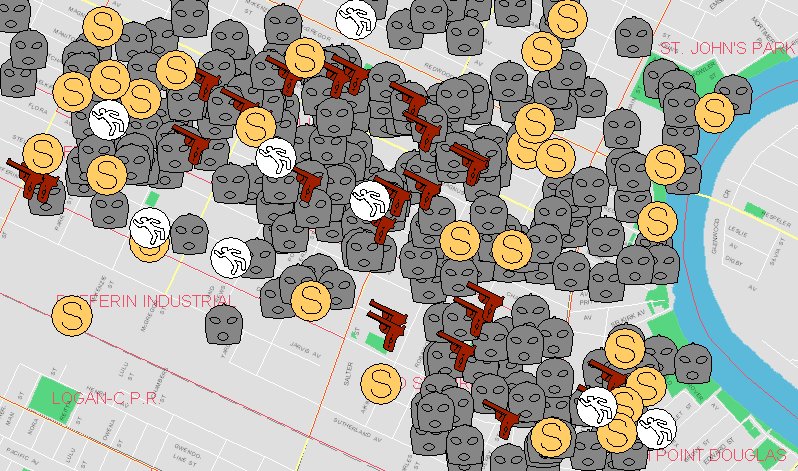
When you look at the Crimestat map depicting homicides, shootings, muggings and sexual assaults in a few of Winnipeg’s north end communities, it’s readily obvious that it’s been awhile since those communities have had a “good day in the City of Winnipeg”.

Winnipeg Police Crimestat (depicting homicides, shootings. muggings and sexual assaults  between January 1st 2010 and December 27 2010)

The mayor went on to say “I assume (the police) are still doing their investigation and will come up with information and hopefully solve it. For all I know, they could have suspects as we speak.”

Unless the mayor is not reading the briefing notes he is sent (or dozing off during his weekly briefings with the chief of police), there is no need for him to make any such assumptions on the progress of an ongoing investigation. To suggest he is taking a disinterested ‘hands off approach’ in terms of the progress of this investigation means he is either a fool or he is negligent.  Politicians need to keep themselves informed and abreast of what is happening.  To pretend otherwise is cause for concern.  The mayor can and should be kept informed about the progress in an investigation of this magnitude and it can be accomplished without piercing the ‘sacred veil’ of police operations.

Lastly, the Mayor says:  “But I don’t know, because I don’t interfere with police investigations. I have never done it before and I have no intention of doing it right now.”

Where is this comment coming from?  Where in the interview is it suggested that he has or may be interfering with police investigations? Why the unsolicited denial?  Even the layperson knows that there is a big difference between being briefed and being kept aware of the progress of police investigations, and interfering in them.  Politicians should keep themselves informed, and they must not yield to the temptation to interfere.

The mayor then qualifies his statement further by saying he has never done it (it being, interfering with police investigations) and that he has no intention of doing it right now.  Never is a pretty strong word. All inclusive, leaves little wiggle room, little room for interpretation. Never means never. Not even once.

The mayor says he will not interfere with the ongoing police investigation “right now.”  Does that mean he is reserving the right to interfere in this or other police investigations in the future?

Election Promises: Part I

During the recent election campaign Sam Katz made a number of promises ranging from pop bottle recycling, additional monies for community centers, and of course, more money for policing.

This will be the first in a series of posts that will examine the policing/community safety commitments made by the mayor during the 2010 election campaign, those being:  the addition of  20 officers for beat patrol; 18 officers for general patrol;  20 officers for a gang unit; and 19 civilian positions for the 911 call center.

Subsequent posts in this series will provide some history in terms of police initiatives and practices as they relate to foot patrols, general patrol and the gang unit.

Putting Additional Officers on the Street

Screening, hiring, training and putting police officers on the street is a long and arduous task.  The majority of the 58 additional police officers promised by the mayor will not be fully trained and ready for street duty until  late 2011 or early 2012.  The next Recruit Training Class is not slated to start until August of 2011, just 2 months prior to the next provincial election.

In light of the fact that the Police Service has more than a year of lead time, they  have an opportunity to give some serious thought to the assignment, priorities and job descriptions for these additional officers.  That’s assuming that the decision as to their deployment will be based on operational needs as opposed to political whims.  Should the gang unit be launched  first, or should the foot patrol officers or the additional general patrol officers take precedence?  Only the Service (or the mayor) will answer those questions.

The decision, whatever it is, will signal whether the Service is going to stay the course in terms of using a largely reactive approach or whether they are ready to embark on a more proactive approach to dealing with crime in this city.

Part II will start by examining the Winnipeg Foot Patrol experience from around 1970 onward and provide backdrop for the decision-making process concerning the assignment of the new foot patrol positions.