Just Answer the Question, Sam

When I read Bartley Kives’ interview with Mayor Sam Katz in today’s Winnipeg Free Press where Kives asked the mayor about the murders in the north end, two things came to mind: firstly,  the answer does not fit the question, and secondly, in the words of Shakespeare, he  “doth protest too much, methinks”.

It is not unusual for politicians to avoid answering questions put to them by the media.

What is unusual (and curious) is when  politicians offer up information that although not relevant to the question invites all kinds of other questions while revealing  their insecurities and self doubt about the things they are doing.

In his year end interview with the Mayor, Bartley Kives asked the Mayor a simple question:  FP: How do you feel about the unsolved triple shooting at the end of October?”

The Mayor’s reply was It was not a good day in the City of Winnipeg, I’ll be blunt with you. I assume (the police) are still doing their investigation and will come up with information and hopefully solve it. For all I know, they could have suspects as we speak. But I don’t know, because I don’t interfere with police investigations. I have never done it before and I have no intention of doing it right now.”

Let’s analyze the part about the shootings not being “…a good day in the City of Winnipeg…”

He seems more concerned with the overall image of the city, but is this the time to be worrying about it in this context?!  What kind of day do you think it was for the 3 people who were shot?  What kind of a day to you think it was for their relatives, friends and neighbours?  What kind of day do you think it was and still is for the neighbourhood where the random shootings took place when they are advised by police that they couldn’t protect them and they should stay in their houses?

When you look at the Crimestat map depicting homicides, shootings, muggings and sexual assaults in a few of Winnipeg’s north end communities, it’s readily obvious that it’s been awhile since those communities have had a “good day in the City of Winnipeg”.
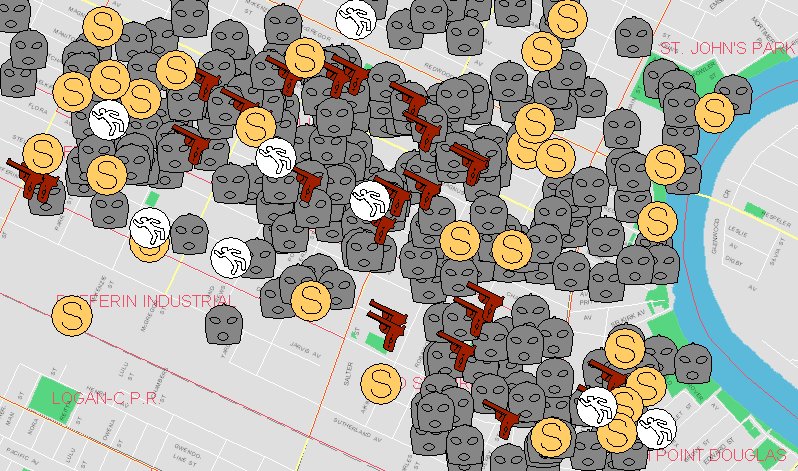
Winnipeg Police Crimestat (depicting homicides, shootings. muggings and sexual assaults  between January 1st 2010 and December 27 2010)

The mayor went on to say “I assume (the police) are still doing their investigation and will come up with information and hopefully solve it. For all I know, they could have suspects as we speak.”

Unless the mayor is not reading the briefing notes he is sent (or dozing off during his weekly briefings with the chief of police), there is no need for him to make any such assumptions on the progress of an ongoing investigation. To suggest he is taking a disinterested ‘hands off approach’ in terms of the progress of this investigation means he is either a fool or he is negligent.  Politicians need to keep themselves informed and abreast of what is happening.  To pretend otherwise is cause for concern.  The mayor can and should be kept informed about the progress in an investigation of this magnitude and it can be accomplished without piercing the ‘sacred veil’ of police operations.

Lastly, the Mayor says:  “But I don’t know, because I don’t interfere with police investigations. I have never done it before and I have no intention of doing it right now.”

Where is this comment coming from?  Where in the interview is it suggested that he has or may be interfering with police investigations? Why the unsolicited denial?  Even the layperson knows that there is a big difference between being briefed and being kept aware of the progress of police investigations, and interfering in them.  Politicians should keep themselves informed, and they must not yield to the temptation to interfere.

The mayor then qualifies his statement further by saying he has never done it (it being, interfering with police investigations) and that he has no intention of doing it right now.  Never is a pretty strong word. All inclusive, leaves little wiggle room, little room for interpretation. Never means never. Not even once.

The mayor says he will not interfere with the ongoing police investigation “right now.”  Does that mean he is reserving the right to interfere in this or other police investigations in the future?

Election Promises: Part I

During the recent election campaign Sam Katz made a number of promises ranging from pop bottle recycling, additional monies for community centers, and of course, more money for policing.

This will be the first in a series of posts that will examine the policing/community safety commitments made by the mayor during the 2010 election campaign, those being:  the addition of  20 officers for beat patrol; 18 officers for general patrol;  20 officers for a gang unit; and 19 civilian positions for the 911 call center.

Subsequent posts in this series will provide some history in terms of police initiatives and practices as they relate to foot patrols, general patrol and the gang unit.

Putting Additional Officers on the Street

Screening, hiring, training and putting police officers on the street is a long and arduous task.  The majority of the 58 additional police officers promised by the mayor will not be fully trained and ready for street duty until  late 2011 or early 2012.  The next Recruit Training Class is not slated to start until August of 2011, just 2 months prior to the next provincial election.

In light of the fact that the Police Service has more than a year of lead time, they  have an opportunity to give some serious thought to the assignment, priorities and job descriptions for these additional officers.  That’s assuming that the decision as to their deployment will be based on operational needs as opposed to political whims.  Should the gang unit be launched  first, or should the foot patrol officers or the additional general patrol officers take precedence?  Only the Service (or the mayor) will answer those questions.

The decision, whatever it is, will signal whether the Service is going to stay the course in terms of using a largely reactive approach or whether they are ready to embark on a more proactive approach to dealing with crime in this city.

Part II will start by examining the Winnipeg Foot Patrol experience from around 1970 onward and provide backdrop for the decision-making process concerning the assignment of the new foot patrol positions.

How To Not Get Your Ass Kicked by the Police

Well known comedian Chris Rock performed a  public service when he put out the video that outlines in a humorous manner how to “avoid getting your ass kicked by the police”.

Although based on the American experience, most of Rock’s ‘hints’ are as applicable in Winnipeg as anywhere else. Following  these common sense  suggestions might save you time and aggravation if you were to have an encounter with the police.

Hint #1  Obey the law

Most law abiding citizens have fewer  negative encounters with police than those who break the law.  Most people have a pretty good idea as to what is and is not legal.  If you don’t,  find out what the law is (in most cases a quick Google search will tell you) and obey it.  That way in the event you are stopped you know what the outcome is going to be.  You will be leaving on your own and end up at home as opposed to the Remand Center courtesy of  a black and white taxi.

Hint #2   Stop Immediately

If the police are attempting to pull you over they usually have a reason for doing so.  Perhaps you violated the Highway Traffic Act or you (and/or your vehicle) match the description of a person or vehicle wanted for a crime recently committed, or you are riding in a stolen car.  Once you see the flashing lights – stop.  Your encounter with police will be less traumatic it they don’t have to chase you down.

Hint #3 Be Polite

Most police officers, when they stop you, will be polite.  Be polite in return.  Do not give the police a reason to not be polite.  If your car is bouncing up and down with the music, take Chris Rock’s advice and ‘turn that shit off’.  If you are asked for your drivers license and registration (which police are entitled to do if you are driving a car), produce them.

Hint #4  If stopped stay in your car with your hands visible

With the number of illegal weapons (guns, tasers, peppers spray) on the street, police have a legitimate concern for their safety when they stop you either as a pedestrian or driving a vehicle.  If the police pull you over while driving your vehicle stay in the vehicle and keep your hands where police can see them.  Don’t be reaching under the seat or your glove box as police walk up to your vehicle.  They may think (and legitimately so) that you are reaching for a weapon.  Stay in the car until police ask you to get out.  If you are stopped as a pedestrian, don’t reach into your pockets, or inside your coat.  If police want you to pull out your identification, they will ask you.

Hint #5  Respond to questions when asked and avoid being verbally abusive

Most times when you are stepped by police they will advise you why they stopped you.  If they don’t, politely ask them for the reason.  Yelling and screaming at police during the first stages of a stop will not work in your favour.  If police are going to ‘detain’ you even for a short period of time, be aware that every citizen has the right under Section 10 of the Charter of Right and Freedoms to being informed of the reason for the detention.  So if you are not told up front, ask –  politely.

Hint #6  Be aware of what passengers in your car have on them

If you are going to give someone a ride and you know that they usually carry a gun, drugs,  other contra ban such as stolen goods or have outstanding warrants for their arrest, you are asking for trouble.  If the police see such a person in your car you will be stopped and the stop may well be treated as a high risk take down so you and your passenger(s) may find yourselves out of the car quickly and spread eagled on the street without a lot of questions being asked.  If you don’t want that have your friend take a taxi or a bus.

Watch the video.  Chris Rock says it so well  and he’s so right.

How To Not Get Your Ass Kicked By The Police

The Benefits of Openness and Transparency in Policing

One of the keys to the development of positive relations between the police and the community is the creation of a culture of openness and transparency in policing.

During my many years as a police officer I found that when police explain what they are doing and why they are doing it, all but a few members of the public (and the media) ‘get it’. They may not always agree but they recognize and understand the rationale.

What is required from police is a willingness to be open and transparent. Police departments have been and continue to be secretive about almost everything they are involved in. Unless, of course, they are looking for media coverage of positive stories or they need media assistance in getting out a message about a particular case where they need information from the public to solve the case.

Greater openness and transparency on the part of police departments would go a long way to improve the police image in the eyes of the public. It would also provide a greater measure of accountability.

Lets look at an example: there are few issues in policing that create more heated debate than police use of force. Police departments are seldom taken to task for high crime rates, low clearance rates or the like. But, an instance of police use of force, especially if captured on video (such as the Rodney King incident in Los Angles, the Robert Dziekanski incident in Vancouver or the Cody Bousquet case here in Winnipeg) focuses public attention on the actions of police.

One of the main issues when these types of incidents come to the public’s attention is that the public, and to a lesser extent the media, are ill-informed about what police department policies are in relation to use of force.

There are several approaches that can be taken to address  issues like this in a proactive way. One is to create greater transparency in terms of police policies and procedures. If, for example, both the public and the media are fully aware of the police department’s use of force policy, and the policy is a public document, a lot of speculation and misinformation could be avoided.

Secondly, if police departments conducted information sessions explaining their policies both for the media and the public, the resulting dialogue would eliminate many of the misconceptions that exist.

Some police departments such as Vancouver and Portland, Oregon have put their procedure manual on-line – a bold and progressive step.

Police in Oakland, California recently invited the community and the media to a seminar that outlined the use of force training received by members of the Oakland Police Department. The seminar dealt with both the legal use of force framework, as well as hands on demonstration of video simulator training.

Initiatives such as these reinforce openness, transparency and accountability to the public on the part of police and create positive dialogue between the public and the police.

Note: The Oakland Police Department has also opened its CompStat meetings to the public.

Starlight Tours In Winnipeg

Myth or reality

The recent allegations by Evan Maud that he was picked up by police and driven to the outskirts of Winnipeg, deprived of some of his clothing, threatened with a Taser and then abandoned, have the potential of setting back relations between the Winnipeg police and the Aboriginal community all the way to the J. J. Harper era.

Since the incidents of police in Saskatoon driving young aboriginal males outside the city and abandoning them first came to light, there have been on going rumours about the same thing having happened in Winnipeg.

When aboriginal people say to each other or their leaders ‘that happened to me’ but fail to come forward and file a formal complaint, they perpetuate what is either a myth or a very serious problem.  If if did not happen, then the Winnipeg Police Service and its members are  being maligned; if it did happen, heads should roll.

I have only one word of advice for Evan Maud his family, and the aboriginal leaders who are advising him:  Make a formal report and do it now. And I don’t want to hear any nonsense about not trusting the police or the process.  In a high-profile case such as this, if the matter is reported it will be properly investigated.

If the matter is submitted for investigation there are basically three possible outcomes:  Either Maud was picked up by Winnipeg Police officers; picked up by men posing as Winnipeg police officers; or, it did not happen.

Either way the matter needs to be investigated, and  appropriate action needs to follow.

Taking Care of Business in the North End: Again

While the  crime rate (for the crimes types reported on Crimestat) in north Winnipeg (police District 3) is basically static a study of specific north end neighbourhoods shows a much different picture.  Crime in neighbourhoods in close proximity to William Whyte is showing a disturbing trend.  The crime rate in these high crime neighbourhoods is rising, in some case dramatically.

The recent multiple shootings in the north end have again focused attention on this part of the city.  It is unfortunate that the only time these high crime neighbourhoods get attention is in times of tragedy.

The map below depicts the crimes tracked on Crimestat for the south-east portion of District 3.

Source:  Winnipeg Police Crimestat

The crime rate in these neighbourhoods is such that the icons depicting the various crimes overlap each other and it is difficult to appreciate the severity of the problem.  For the sake of clarity one needs to eliminate some of the crime types.  The image below illustrates the violent crimes (murder, shootings, robberies and sexual assault) for the area in question.

Source:  Winnipeg Police Crimestat

A further examination of the crime trend in seven specific north end neighbourhoods shows the following increases:

Neighbourhood 2010 Year to Date October 2009 toOctober 2010
William Whyte 1% 5%
Dufferin 11% 18%
Burrows Central 15% 13%
Robertson 25% 25%
Inkster-Farady 38% 30%
St. John’s 23% 26%
Luxton 16% 32%

Source:  Winnipeg Police Crimestat

The important issue with these data is not so much the actual increase but rather the trend they represent.  Increased crime in high crime neighbourhood or a cluster of neighbourhoods clearly demonstrates the area is not-self sustaining and needs help.  The approach currently employed in these neighbourhoods is not working

The north end communities clustered around the William Whyte have received sporadic attention over the past couple of years usually related to tragedies such as shootings and homicides.  When tragedies occur everyone (the police, the mayor and other civic and provincial politicians and the media) expresses outrage and vows are made to leave no stone unturned to bring the killer(s) to justice.  As indicated in a previous post the police flood the area with additional personnel and the hunt is on.

Such a sudden influx of police resources is in and of itself not a bad strategy, in the short-term.  It becomes problematic when it is the only strategy.  Flooding high crime neighbourhoods with additional police resources drawn from other areas (operational and geographic) is not a sustainable strategy nor is it a strategy that addresses the long-term needs of the neighbourhood and its residents.

Earlier this year police resources were shifted from the north end (and other parts of the city) to the west end to deal with shootings there.  Now resources are being shifted away from the west end back to the north end.  This endless cycle of shifting  resources to deal with emergency situations that crop up is symptomatic of a poorly planned (or unplanned ad hoc and reactive) approach to dealing with crime in high crime neighbourhoods.

The secondary flaw in the constant shifting of resources strategy is its reliance on using a strict law enforcement approach to address a much broader social issue.  You may be able to apply a strict law enforcement approach and arrest you way out of a purely law enforcement issue but you cannot arrest your way out of a social issue.

The problem is that many tradition bound police executives are tethered to the strict law enforcement approach.  They are not adequately familiar with cutting edge approaches to neighbourhood redevelopment and neighbourhood capacity building. Many don’t see that as a policing function.  It may not be a policing function in the strict sense of the word, but what neighbourhood capacity building does is it empowers people and helps prevent crime.  Based on the policing principles laid down by Sir Robert Peel (which in my view are still very applicable today) the prime mandate of the police is crime prevention.

The important issue is not how you strengthen neighbourhoods and reduce and prevent crime but rather that you do it. For high crime neighbourhoods in Winnipeg if that means the police need to go down ‘the road less travelled’, then let the journey begin.

The nature of the issue (problem) must dictate the approach.  As well the nature of the issue must determine the timeline.  Complicated social issues cannot be resolved using simplistic short-term strategies and tactics.

The question is this:  is the Winnipeg Police Service willing to make the leap from using a traditional short-term reactive law enforcement approach to dealing with issues in high crime neighbourhoods to using a long-term proactive approach?

The Service certainly has the tools, the personnel and the budget to make it happen.  The question is: do they have the will?

The Sam’s Plan and a Few Things The Sam Did Not Mention

Fighting Crime The Sam’s Way

In his full-page ad in the October 16th issue of the Winnipeg Free Press, the self-proclaimed “Tough on Crime”  Sam outlined his accomplishments during his six-year tenure as Winnipeg’s Mayor.  At least two (and perhaps more) of Sam’s accomplishments were not mentioned.

The first: Closed Circuit Television in the downtown area.  The Sam fails to mention this $450,000.00 vanity project.  Why not?  Normally when cities institute this type of program they flood the media with details about arrests that resulted from the project.  They outline how the initiative has reduced crime and made the area safer.  We have heard none of that which leads one to conclude that perhaps it has not had the positive impact it was meant to have in terms of preventing crime. Perhaps if you had just spent close to half a million dollars (enough money to put 5 police officers on Winnipeg streets for a year) on a failed project you would not mention it either.

The second accomplishment which has turned into an ‘unmentionable’ is truly puzzling as it was indeed a bona fide accomplishment.  The introduction of Crimestat in 2007 held great promise in terms of identifying crime trends and hot spots and more importantly, directing and guiding police action.  Crimestat is a tool that has proven successful in reducing crime in virtually every North American jurisdiction it has been used and yet seems to have lost favour within the Winnipeg Police Service.  As mentioned in a previous post on this topic, the Executive of the Winnipeg Police Service has turned its back on the one tool with a proven track record of producing results when it comes to crime reduction.  Is The Sam turning his back on it?  What other explanation for avoiding mention of it when he originally introduced it with such fanfare?

The really sad thing is that Crimestat, if used in conjunction with a true commitment to community policing and a problem solving approach, could be an immense asset to the Police Service and the community in terms of crime reduction and community revitalization.  However, not only does The Sam avoid mentioning it, the Police Service is not using it as it was originally intended: to reduce crime in crime-ridden communities.  Instead residents are told to stay in their houses until it is safe to come out.  That could be a long stay.

Now, on to what The Sam did mention.  The Sam, backed by the endorsement of the Winnipeg Police association, has pledged to increase the number of police officers by 58 officers.

There are several problems with this approach.  First, increasing the number of police officers has been The Sam’s perennial answer to crime.  It has become as predictable as the mayor saying either ‘I’ve done that; am doing that; or will be doing that’ anytime a valid suggestion is made to improve the delivery of police service in Winnipeg or any other civic issue for that matter.  The Sam keeps doing the same thing and expecting a different result.  In a recent interview I made the observation that repeatedly doing the same thing and expecting a different result is one definition of insanity.  Perhaps what requires closer examination is not only the number of officers but rather the direction that officers are currently receiving from their executive in terms of goals, objectives, strategies and tactics.

Continually alternating between flooding the north end and the west end with large numbers of police officers every time a flare-up occurs is not the answer to long-term crime reduction and the creation of safe neighbourhoods.  That approach is a lot like flooding a combat zone with troops without an exit strategy and then just picking up and leaving without having put in place the needed infrastructure to ensure long-term stability in the neighbourhood.

On to The Sam’s actual promises:

Twenty new positions for a dedicated Gang Unit.  This could be positive if the unit can be convinced that its function is something else than gathering intelligence. Dedicated units with narrow mandates tend to fixate on intelligence gathering as opposed to operations.  A twenty persons unit could help make a difference if its mandate is clearly defined in terms of goals and strategies to achieve those goals.

Eighteen additional officers of staff one 2-officer unit 24 hours a day.  The Winnipeg Police Service has enough personnel assigned to uniform patrol to staff 27 two-officer units 24 hours a day 365 days a year.  Actually,  some Division Commanders question that.  It seems in some divisions the staffing ratio of 18 officers per unit is not quite there, but on paper it is.  The real question is where will this unit be assigned.  Will it simply be swallowed up in the vortex of calls for service?  If it is,  the addition of one unit will make little difference.  This could have been an opportunity to perhaps introduce additional 1-officer units with a very specific mandate centered on crime reduction activities.

Twenty new officers dedicated to foot patrol. The biggest question that has been left unanswered as it relates to this campaign promise is the establishment of beats in terms of location, and the mandate of the officers assigned.  Simply walking in circles in the downtown area will do little to create safer communities in the north end and west end of the city.  Simply assigning beat officers with a law enforcement mandate will do little to bring about community revitalization and the creation of safer communities.

The larger problem with specific political assignment of police personnel at election time is this:  it demonstrates that the police service itself has failed to address its failures.  If police fail to recognize the severity of the issues facing them and fail to develop a comprehensive strategic plan complete with goals, strategies to achieve those goals, and performance measures to gauge success (or failure) and personnel requirements to implement the plan,  then politicians step in at election time and make promises that are politically motivated and tie the hands of police in terms of deployment of personnel.  And the police cannot blame anyone but themselves.  If their inactivity or inability to develop a cohesive plan of action, or to use the tools at their disposal (such as Crimestat), creates a vacuum in terms of leadership and direction, the situation is ripe for political opportunism.  The Sam sensed the opportunity and ran with it.

The Sam is the Man?

Based on the full-page ad that ‘The Sam’ purchased in the Saturday, October 16th edition of the Winnipeg Free Press, THE SAM must be quite the guy.

Apart from being mayor, it appears that sometime between 2004 and the present he also became the Chief of Police.   The Sam did not just support the efforts of the Winnipeg Police Service, MPI, Manitoba Justice and the other partners involved in initiation of the Auto Theft Suppression Strategy (which has been a local success story in terms of reducing auto theft in Winnipeg).  According to the advertisement, The Sam, all on his own, “Reduced auto theft by 74% since 2004”. Now that’s quite a feat.  Way to go Sam.

And it does not end there.  The Sam in the role as ‘Chief of Police’  “Purchased a police Helicopter to free up on-ground resources”. Actually The Sam didn’t purchase anything.  The Sam used Winnipeg taxpayers money (to the tune of 3.1 million dollars) and an additional 1.3 million dollars in annual operating cost (funded by the province) to pad his resume for this election.  Notice that the anticipated outcomes related to the helicopter are very limited and understated.  The advertisement claims only that a helicopter will “free up on-ground resources”.  It does not indicate the degree to which on-ground resources will be freed up.  More importantly it does not claim that a helicopter will reduce crime, probably because it can’t be proven that it indeed will.

The Sam’s crime fighting efforts don’t end there.  During lulls in criminal activity the Sam in his assumed role as the Chief of Police “Implemented the Mobile Street Crimes Unit and full time Tactical Unit to fight crime”.  (I’m assuming that if there is a mobile Street Crimes Unit then there must also be a stationary Street Crimes Unit which no doubt is being kept in reserve for ‘mobilization’ when crime really gets bad in Winnipeg.)

Don’t go away now.  There is more.  Just recently The Sam, according to his re-election advertisement, “Implemented the new police cadet program to free up police to arrest criminals”.

It seems that other than single handedly bringing auto theft to its knees between 2004 and the present, many of The Sam’s ‘accomplishments’ are recent and in several cases have not yet come to fruition.  The timing of the implementation of several of the ‘accomplishments’ was no doubt intended to coincide with the election; unfortunately for The Sam they are behind schedule so there will be not pictures of The Sam taking an expensive ride in a police helicopter at taxpayers’ expense and no pictures of The Sam going for a walk with police cadets.

Perhaps what is really interesting is not only what The Sam did or claims to have done but the list of things he (or the Police Service) did that he fails to mention.

The things he did not mention and The Sam’s Plan for the future will be the subject of another post.

Winnipeg Police Association Endorses Sam

Buying the Union Vote

I’m sure Sam is grinning from ear to ear – now that he (the conservative candidate and not Judy WL) has the endorsement of the Winnipeg Police Association (WPA) the union that represents Winnipeg police officers and staff members.  Unions traditionally support candidates with a labour background – but not the WPA.

The Winnipeg Police Association is a different sort of union.  With the vast majority of its members being police officers (the WPA also represents the staff sector), there is nothing left leaning or labour oriented about its membership.  Police officers tend to be conservative in their values and political orientation.  It comes with the job.  The WPA is largely a union in the same sense that the NHL Players Association is a union.  The ‘union’ is a vehicle that allows them to bargain collectively – no more and no less and that is where their unionism ends.

So how did Sam ‘buy’ the support of the union that isn’t really a union?  Largely by promising to increase their membership.   Do the math: unions are funded through union dues.  More members mean more money in union coffers.  In this case the addition of 77 members represents additional cash flow into the WPA coffers in the amount of approximately 30 to 40 thousand dollars a year.

The WPA is apparently prepared to enter into this unseemly arrangement in return for more money and more power.

Sounds cynical?

The fact is, Sam has got this one figured out at least in the short-term and right now I don’t think Sam is thinking much past October 27th 2010.   In the long-term, the more powerful a union becomes, the more potent  an adversary it will be  when it’s time for collective bargaining.

In the event Sam is re-elected the time will come when WPA will call in its chips and remind the mayor “We endorsed you”.   When that happens, the old adage of ‘pay me now or pay me later’ may well change to ‘pay me now and pay me later’.

At this point it is not known whether the mayor sought the political endorsement of the WPA and the union agreed, or whether the union proposed the endorsement and the mayor accepted it.   But it really doesn’t matter who courted whom because in an ethical sense, both sides in this questionable arrangement are on the precipice, if not the downside, of the proverbial slippery slope.

Photo Radar Dumped by the State of Arizona

In mid-July of this year the use of photo radar on Arizona State freeways was abandoned.  Governor Jan Brewer made the decision not to renew the contract with Reflex, an Australian company.

Since photo radar was introduced on Arizona freeways in 2008 it has faced intense opposition.  The opposition centered on privacy issues and the feeling that photo radar was not a safety initiative but rather a revenue source for the State.

When photo radar was introduced in Arizona the plan was to use 100 cameras and the projected revenue was in the area of $165 million.  Ultimately 36 fixed and 42 mobile cameras were put into operation.  Since 2008 a total of 1.2 million tickets have been  issued.  The tickets issued represented revenue of over $200 million – had they all been paid, that is.

The problem is that only 432,367 of the 1.2 million tickets issued were ever paid (about a third).  The state collected only 78 million dollars in revenue – far short of the projected 120 to 165 million.

Why were the tickets not paid?  Because the majority of Arizona residents chose to simply ignore them.

In democratic societies laws are passed by elected officials.  Laws that do not have public support are unenforceable.  The state relies on voluntary adherence to the law, it simply does not have the resources to enforce laws that the majority of the public does not support.

In the case of Arizona this created a conundrum.  Normally when a citizen is charged with an offence and fails to attend court to deal with the matter, a warrant to apprehend is issued.  If the State had continued with photo enforcement, it would have been in a position where they would have had to issue warrants for the arrest for approximately 800,000 of its citizens.  This would have been unpalatable politically, and in a practical sense, no state has the police and court resources to deal with such an influx of cases.

Groups lobbying against the use of photo radar were not successful in getting the issue placed on the ballot for fall elections.  They are, however, not giving up their fight.  Although the State of Arizona no longer uses photo radar local jurisdictions such as Tempe, Mesa, and Phoenix still do.  Organizers vow to put the photo radar question on the ballot in those cities.  Their plan is to get rid of photo radar, one city at a time.

In Winnipeg in 2008 the Winnipeg Police Service issued a total of 192,202 traffic tickets.  Of those, 167,569 were issued as a result of images captured by photo radar.  The biggest increase in 2008 was tickets issued by mobile photo radar units which rose to 118,692 – an increase of 59% over 2007.

The 2009 figures will be contained in the 2009 Winnipeg Police Annual Report which is usually issued midyear.  As of this date, the report has not yet been released.

Hopefully it will be available prior to the upcoming civic election.