Traffic Tickets: A New Bargaining Chip for Police Unions

Police departments have become addicted to traffic ticket revenue much in the same way that other levels of government are addicted to revenue from gambling and lotteries.

From a policing and road safety perspective, ticket revenue was never intended to become a major revenue stream.  Ticket revenue was a by-product of traffic enforcement.  In its purest form traffic enforcement is conducted as an evidence based activity targeting either particular offences or particular locations that, based on the evidence, can be shown to detract from road safety.

Police departments have the ability to gather the required intelligence to be able to set enforcement strategies based on objective criteria that link enforcement to road safety and not revenue.  However, no matter how desirable an increased level of road safety may be, it does not translate well into dollars to fill gaps in police budgets.  The result is that many police departments continue to utilize enforcement strategies that maximize the number of tickets issued and the fine revenue generated – and not road safety.

Police Unions are quickly picking up on this trend and traffic enforcement, or rather the lack thereof, is becoming a powerful bargaining chip for police unions.  Existing legislation on issues such as arrest and the issuing of traffic tickets is worded in such a way that officers “may arrest” or “may” issue a ticket.  It does not say they shall or must.  Officers have discretion and may use other approaches to deal with traffic violators.  Legally they are allowed to issue warnings as opposed to issuing tickets.

It seems that some officers in Dekalb County, Georgia are doing just that.  In June and July of 2009 the number of traffic citations issued by officers dropped from 23,797 to 19,029 and from 22,716 to 15,783, respectively, compared to 2010.  That is a 20% drop in June and a 30% drop in July.

The DeKalb County Police Department recently imposed an unpaid holiday policy that is not going over well with officers.  The union representing the officer denies that officers are on a ‘ticket furlough’ but do admit that there has been a decrease in morale. The Chief blames the reduction in tickets on other factors such as manpower, call volumes and officers’ use of discretion.  The reduction in tickets issued in June and July of 2010 represents 1.75 million dollars in lost revenue.  In 2010 DeKalb County projected 25.9 million dollars in ticket revenue.

Meanwhile in Spain, Guardia Civil (highway patrol officers) are protesting the introduction of a productivity bonus system that relates pay to performance.  In Spain fine revenues from tickets issued by Guardia Civil  in June of 2010 dropped 50% compared to June of 2009 despite increased patrols.  Guardia Civil does not have the right to strike but an unnamed union official said that highway patrols have every right to be ‘gentle’ with drivers.

The size of the bargaining chip or ‘hammer’ being handed to police unions is determined by the degree to which the organization is dependent on traffic ticket revenue.  A city or police department that plugs  large numbers (in the millions) into its budget from anticipated traffic fines can experience a hard fall if those numbers drop off, for whatever reason.

Jurisdictions that use photo radar technology for the bulk of their traffic fine generation may be somewhat immune to this phenomenon.   Machines (photo radar), once installed, cannot take furloughs, go on strike or use discretion.  They just churn out tickets and revenue 24 hours a day, 365 days a year.

Dealing with Crime at Election Time

Let me begin by using an analogy:

When the British Petroleum well in the Gulf of Mexico exploded, spewing million of barrels of oil into the water, two simultaneous approaches were implemented to deal with the issue.  First, immediate attempts were made to cap the well to stop the flow of oil, and secondly, remediation efforts  were employed to deal with the effect of the spill in terms of doing clean-up along the coastline of various southern states.  Both the cause and the effects were dealt with.

Now, let’s draw a comparison to crime in Winnipeg:

Traditional reactive policing can be compared to relying on remediation efforts as a means of addressing the issue of crime.  You allow the well (in this case, crime) to spew unabated and spend most if not all of your policing resources on cleaning up the mess created by criminal activity.

The problem is that it never ends.  The well spews out new criminals on a daily basis and the system is caught up in a catch 22.  The police are so busy attending calls for service, making arrests, seizing evidence and testifying in court that they have little time left to perform in a proactive manner.  Nor is there time left to enact preventative measures.  The result: the well never gets capped.

A preventative mindset would see police employ an approach that focuses much greater attention to capping the well;that is, activities designed to reduce criminal activity and to keep young people from becoming involved in criminal activity.  A preventative mindset and a proactive approach are long term strategies.  It involves recognizing the need for some short term pain for long term gain.  It involves investing in the future of our community.

One of the problems in terms of the municipal approach to policing is the definition of ‘long term’.  For municipal politicians, long term means their current term in office.  A 3 or 4 year term is not long enough to enact significant changes and produce results from a policing and crime prevention perspective.  Municipal politicians are more attuned to the`flavour of the day approach’.  Crime prevention is not a sexy political issue.   More uniform officers on the street,  CCTV cameras, a gang unit and a helicopter may not solve our crime problem but they certainly are bound to create attention-grabbing headlines to hang your hat on at election time.

It’s about time the electorate woke up and had a close look at how the current civic administration is spending our money.  Municipal taxes are meant to pay for civic infrastructure and services.  They are not meant to be squandered at election time by politicians seeking to buy our votes with our own money.   The problem of crime is not solved by political expediency.

Although oil wells can be capped completely, stopping the flow of oil, no one is naive enough to believe that all crime can be totally eliminated through preventative measures.   But nor does it take a rocket scientist to comprehend that leaving the well uncapped means crime will keep increasing, the police will continue to be overtaxed with calls for service, and the cost of providing municipal services will keep increasing.

I’m waiting for a mayoralty candidate that is prepared to stand up and say “I’m going to devote resources to capping the well”.

Answering 911 Calls – Not a New Issue

The recent administrative report submitted to Standing Committee on Protection and Community Services by the Winnipeg Police Service makes it sound as though the results of the recent review of the Winnipeg Police Communications Centre efficiency level came as a surprise to the Winnipeg Police Executive.

Who knew that 911 calls were not being answered in a timely manner? How did this issue progress to the point that, to quote from the report, the existing situation in the Communications Centre created a “risk that is not acceptable”.

I’m sure the call takers knew just as I’m sure their supervisors knew. I’m even quite sure that the Winnipeg Police Association knew. Unfortunately all the people that ‘knew’ were not in a position to effect change.

The issue of workload, outputs, outcomes, efficiency and cost effectives were addressed in the City of Winnipeg Audit Department report submitted in June of 2002 upon conclusion of their audit of the Communications Centre. Recommendation 32 of that reported stated:

The WPS Executive and Centre management should monitor the performance of the Centre on a regular basis. Periodic performance reports should cover the entire spectrum of the Centre’s activities and include measures of output, outcome, efficiency and cost effectiveness. Periodically, the actual results of the Centre should be compared to internal and external standards and benchmarks. As the objectives change, the performance targets and measures also need to be evaluated to determine if they require modification.

The Winnipeg Police Service Executive at that time committed to developing a report format that addressed the issues of performance and effectiveness, as well as to conducting periodic comparisons with internal and external standards and to benchmarking.

What is missing from the report to Standing Committee is any information about previous performance and benchmarking reports. One would be led to believe that this high risk situation developed suddenly. Do previous reports exist? If they exist, do they perhaps show a continuous trend of increased workload and a steady deterioration in the  level of service delivery over the past several years that was not addressed and  that the Police Service and the politicians don’t want to talk about now,  just before an election?

So why does this request now come before Standing Committee in September of 2010? And why does the request align so perfectly with the Mayor’s pre-election promises? Could it be that the Mayor instructed the police service to do this study (or other studies for that matter) so as to identify areas of police concern that he could incorporate into his election platform?

Back in the day when I was doing high school geometry we learned about a theorem called congruency. It basically says that if the 3 sides of a triangle are the same length and the angles match, the two triangles are congruent. We have here a scenario whereby the Mayor makes an election promise, the Police Service submits a report that asks for exactly what the Mayor has just promised, and on the day the announcement is made the Winnipeg Police Association endorses the Mayor. An argument could be made that we have congruence here, especially when each of these announcements falls perfectly one on top of the other like dominos – almost like it was planned.

Only during ‘silly season’, you say?

The complete City of Winnipeg Audit Report is available at: http://www.winnipeg.ca/audit/pdfs/reports/WPS_CC_Report.pdf

Radar Units With LED Displays

For the past several years Winnipeg’s photo radar program has received some bad publicity.  In the eyes of many it has morphed from a road safety program to a revenue generating program.  Some of you have actually started calling it a cash grab.  Others, including a Provincial Court Judge, have questioned whether the Police Service and the City in their zeal to raise photo radar revenue  complied with the law.

The Mayor has decided to take steps to address this issue.

In order to dispel the ‘cash grab’ image, the mayor has decided to ‘invest’ our tax dollars and has spent $100,000.00 to purchase a number of radar units with LED displays.  These units will tell motorists exactly what their speedometers currently do but using much larger numbers and in colour!  Winnipeggers are no doubt excited about this new initiative, just another example of the efficient and effective use of  their tax dollars.

Because the mayor is now also spending money on photo radar and not just generating revenue he wants us all to be reassured that photo radar is really all about safety, and not about the money.  The Chief of Police has described the project as a ‘worthwhile investment’ –  probably because the mayor told him it was.  And although the Chief of Police did not come up with this idea himself, he does support it and as with other initiatives proposed by the Mayor (such as the helicopter and CCTV),  the  Chief has clearly demonstrated a keen sense of  political savvy by falling in line with the mayor’s thinking.

Some members of the public view this  ‘investment’ as a red herring to distract attention away from the ‘money grab’.

And for those of you that, in your cynicism, thought this might be an election ploy – forget it.  The mayor actually thought about this idea last year and the timing of the implementation is strictly a co-incidence.

Much like former President Richard Nixon used to proclaim, “I am not a crook”, Winnipeg’s mayor has repeatedly proclaimed “I am not a politician”.   How could any of his actions, therefore, possibly be viewed as politically motivated if he is not a politician?

(Authors note:  Actually, it turned out that despite Richard Nixon’s repeated proclamations to the contrary, history showed that he was indeed a crook.)

Honesty and Trust No Longer Winnipeg Police Core Values

Commitment to Excellence also eliminated as  a core value

Although the changes may not  be readily obvious to the public in terms of how the Winnipeg Police Service operates, the Service made the decision to alter its Vision and Mission statements  a few months ago.  At the same time, the core values of the organization were changed.

The core values of an organization are intended to be fundamental values that serve as reference points for operational decision making on the street and administrative decision making at the executive level.

The following core values have been eliminated:

  • Honesty – Being truthful and open in our interactions with each other and the citizens we serve
  • Trust – Being honourable and maintaining a high level of trust with each other and the members of our community
  • Commitment to Excellence – Adhering to a strict standard of conduct and performance in everything we do

The core values that were nominally retained are integrity, respect and accountability although the definitions applied to the terms have been altered.

Added as  core values are:

  • Citizen Focus – Conducting ourselves in a professional manner at all times, showing pride in service and commitment to serve the greater good.
  • Courage – Serving on the street and in leadership roles, being ready to make tough decisions to valiantly protect people and their property

The mission statement has also changed.  The new Mission Statement for the Winnipeg Police Service is as follows:

As members of the Winnipeg Police Service , we are committed to making Winnipeg safer by:

  • Performing our duties with integrity, compassion and respect,
  • Building strong, trusting relationships with the community because we can’t do it all alone,
  • Enhancing our effectiveness so we can be there when we’re needed the most, and
  • Finding innovative ways of delivering our services.

Lastly the Service’s vision statement has been changed.  The vision now is:

A safer community, built on strong, trusting relationships

Reactions from within the Service are mixed and varied ranging from indifference to complaints that the process used to establish the new vision,  mission and values was exclusionary and did not allow for street level input (constables and sergeants).  Some within the Service also suggest that the `building relationships` phrase is getting a little tired.  Poorly defined terms, especially when overused, risk losing their meaning and credibility.  There is a difference between a slogan and a philosophy and in this case that difference has never been convincingly established.

Changes to an organization`s vision, mission and values are usually a precursor to the development and unveiling of a comprehensive strategic plan.  Such a plan would generally include goals, strategies and measurable performance indicators.  It is not known if the Winnipeg Police Service  developed strategies and performance indicators.  If they have not, then the vision and mission statements are essentially meaningless.

For an example of a well developed strategic plan visit the Vancouver Police website at :

Click to access vpd-strategic-plan-2008-2012.pdf

Winnipeg Police Cars to Sport a New Colour and Logo

Community Commitment is out, ‘Building Relationships’ is in.

Members of the Winnipeg Police Service have been asked to participate in a selection process to choose a new ‘look’ for Winnipeg Police patrol units.  The process will involve members visiting Policenet, logging in and casting a vote for one of two designs.

The new look will feature a black on white as opposed to blue on white color scheme.

The colour is not all that’s being altered.  The Police Service’s long standing motto “Community Commitment” will be removed and replaced by the current administration’s favorite buzz words.  You guessed it, patrol units will be adorned with “Building Relationships”.

It is not anticipated that the words “Community Commitment” will be removed from the Police Service badge.  The heraldic design and wording  incorporated in the badge was personally approved by the Queen.  Any change to the badge would require royal approval.

According to a recent email sent to all members of the Police Service by the Chief,  the new colour scheme and logo is designed to enhance safety in terms of greater visibility, improve the image of the Service, and increase officer morale.

The two proposed patrol unit designs are shown below.

Winnipeg Police Shy Away From the Media

(And the main stream media lets them get away with it)

The Winnipeg Police Service was one of the first police agencies in Canada to conduct daily media briefings.

Daily media briefings give the police service the opportunity to notify the media about major crimes that have occurred in the city. It also gives the media the opportunity to ask questions.  Media briefings serve a valuable role in terms of police accountability to the public and assist in ensuring transparency.

During the months of March, April and May of 2009 the Winnipeg Police Service cancelled the daily media briefings on 29 occasions.  That’s 31% of the time.

In March, April and May of 2010 the Service cancelled 38 media briefings.  That’s 41% of the time.

Why is the Service cancelling so many media briefings?  From looking at the crime numbers it would seem that there is no shortage of crimes to report on.  Could it be that the media has lost interest in crime issues and the workings of the police service?  Perhaps.  It seems to me that the main stream media is placing less emphasis on the police beat than they have in the past.

Another theory might be that the Police Service is bowing to political pressure to minimize crime issues in the period leading up to civic elections.

When the media asks the tough questions it challenges the police to perform at a higher level.  It results in a closer examination of the issues at hand both in terms of public debate and discussion internally within the police service.  The public safety agenda and public safety policy are not only dependent on those who do the patrolling and arresting but also on open public debate of the issues.  The role of the media is to help focus that debate.  We need the media to ferret out the pertinent issues and ensure they are brought to the attention of the public.

There is a delicate balance between institutions that has evolved over many years.   The role of the media as a watch dog over public spending, public policy and policing has been part of that balance.

It seems unfortunate that the main stream media in the performance of its ‘watch dog’ role has gotten old or tired or perhaps lost its teeth.  The public needs a media that does more than gnaw on the bones they are thrown.  The public needs a media that actually goes out and looks where the bones are buried and unearths the issues and subjects them to debate and scrutiny.

The role of the media is not to create a comfort zone for public institutions such as the police.  Their role is to create a comfort zone for the public  When the media does its job, the public gets closer to what it needs and deserves.

Using Crimestat to Best Advantage

What is Crimestat and how does it work – a brief history

On July 26th 2006 Council passed a resolution that directed the Administration to report back to Executive Policy Committee (EPC) and the Standing Committee on Protection and Community Services on the following:

What, if any, additional resources will be required to develop and implement a COMPSTAT style management and accountability mechanism that will provide weekly updates to citizens on crime trends on a geographical basis across each of the Police Districts; and, propose how the existing Police Command structure with its specialized operational units can be augmented by weekly organizational and strategy meetings chaired by the Chief of Police to respond to crime and safety concerns across each geographical districts and coordinate Clean Sweep Task Force Operations; and

How the Administration proposes to measure Police Service outcomes related to crime prevention and enhancement of neighborhood safety.

This direction resulted in the preparation and submission of a report outlining a Neighborhood Safety and Crime Prevention initiative which became known as Crimestat.

The nuts and bolts of the Crimestat initiative are contained in a report from the Police Service to Standing Committee dated January 5th 2007   which can be accessed at:

http://www.winnipeg.ca/clkdmis/ViewDoc.asp?DocId=6830&SectionId=&InitUrl=  (look under Reports at the top of the page and scroll down to #85)

For the casual observer, Crimestat is simply a website that displays crime statistics and crime maps.  For police, it’s significance is far greater.  Crimestat is a management and accountability strategy that directs police commanders to concentrate on emerging crime issues and trends in the area under their command.  It forces them to track criminal activity in their area, identify emerging crime trends, develop effective tactics, and deploy resources quickly to deal with emerging trends in their early stages before they develop into a full blown crime spree.  Lastly, there is follow-up and assessment by the executive.  This is the accountability feature of the process that ensures everyone (commanders in particular) have their eyes ‘focused on the ball’, the ball being crime prevention and crime reduction.

When Crimestat was introduced in Winnipeg in 2007 many were convinced that it could be a useful tool to prevent crime, not in the traditional crime prevention sense in terms of programming, but rather in an operational sense.  What is visible on the public side of the Crimestat site is less detailed than what is available on the police side.  If one studies the numbers (on the police side), specific crime trends can be seen developing in specific areas of the city.  These trends can be nipped in the bud so to speak, largely by identifying and arresting perpetrators.  These preemptive arrests prevent the trend from continuing and reduce the amount of crime.  It’s not the be all and end all but it is a valuable tool.  Like any tool, though, in order for it to work effectively a few basic rules must be followed.

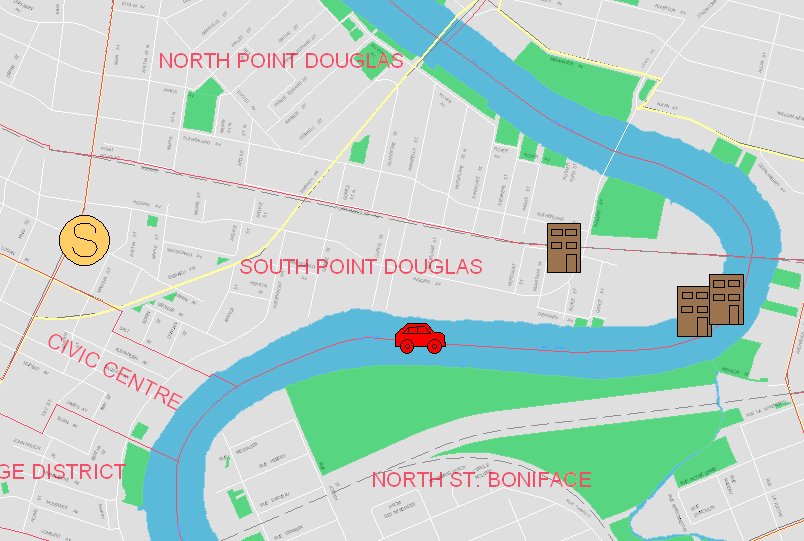
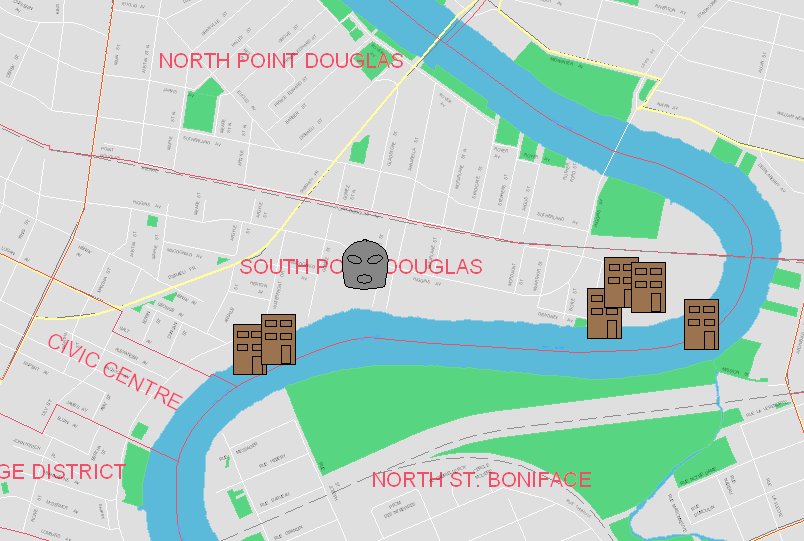
Here is an illustration of how it works:  Using the neighbourhood of South Point Douglas as an example we can go back and have a look at the early stages of what looks to be a pattern of commercial break-ins.

Going back to July of  2009 (on the public site of the Crimestat site you can only go back one year) we see that during the months of July there were 3 break-ins in South Point Douglas.

For the sake of this exercise we will make that the starting point of a ‘trend’.  

July 2009 (3 break-ins)

Source: Winnipeg Police Crimestat website

August 2009  (3 break-ins)

Source:  Winnipeg Police Crimestat website

September 2009   (6 break-ins)

Source:  Winnipeg Police Crimestat website

This trend continued with 0 in October, 3 in November, 1 in December, 3 in January, 0 in February, 4 in March, 2 in April and 5 in May.

At the end of almost a year the crime map for South Point Douglas looks like this:

July 1st 2009 to May 30th 2010

Source:  Winnipeg Police Crimestat website

During that 11 month period there were 30 commercial break-ins in the South Point Douglas neighbourhood.

Police Commanders are provided with this information virtually in real time.  As a trend such as this one develops, commanders assign resources and tactics are developed.  That is, if the series of events is recognized as a trend.  Because there is a high likelihood that these 30 break-ins in close proximity to each other were not committed by 30 different perpetrators but rather by 1 or a group of individuals known to each other, the trend can be halted by identifying and arresting that individual  or group of individuals.

Had that been done back in  July of 2009 when the first break-ins in South Point Douglas occurred the next 30 could perhaps  have been prevented.

That is a simplistic example of how division commanders can use Crimestat to prevent crime.  The principle can be applied to other crimes at the community level.

Crimestat was designed to be a tool to track crime in our city’s neighbourhoods.  It does that very well.  The process has a proven record in helping to combat crime throughout major cities in North America.  In order for it to be  effective the tool must be used in the manner it was designed to be used.  All players in the system must understand and execute their roles.  Division Commanders must stay on top of crime in their area, identify trends and devise effective tactics to deal with them.  The Police Executive must be fully engaged and ensure the resource is used as intended.

The executive of the Winnipeg Police Service does not appear to understand or appreciate the capabilities of Crimestat and that could explain why they have largely turned their backs on it.  A key aspect of the Crimestat process centers on  accountability.  The Executive needs to hold Division Commanders accountable. Accountability is exercised most visibly during Crimestat meetings.  That cannot happen if the Executive does not attend Crimestat meetings.   Residents of Winnipeg have a vested interest in the overall safety of all neighbourhoods.

Winnipeggers need Crimestat to work.

Where Crime is Taking Place

All it takes is a glance at the Winnipeg Police Crimestat website to see that there is no real surprise here in terms of the recent shootings in the City’s West End.  And certainly no need on the part of the police to be shocked as they recently claimed.

When it comes to homicides, shootings, sexual assaults and muggings (the four main crime types being tracked by Crimestat that are classified as  “crimes against persons”), Crimestat tells the public exactly what most police officers working in Divisions 11 and 13 are already aware of.  These four specific types of crime occur with alarming frequency in Districts 1 and 3 and more specifically in rather small geographical areas within those two Districts.  As seen below, the first Crimestat map makes that point:

City wide map showing homicides, shootings, sexual assaults and muggings from June 16th 2009 to June 14th 2010.

Source:  Winnipeg Police Crimestat website

The above map shows two very distinct data clusters, one in District 3 and an even larger one in District 1.  The two maps below show a close up of those two areas and leave no doubt as to the high number of homicides, muggings, shootings and sexual assaults.

Crimestat map showing homicides, shootings, sexual assaults and muggings in a portion of District 1 for the period June 16th 2009 and June 14th 2010.

Source:  Winnipeg Police Crimestat website

Crimestat map for a portion of District 3 depicting the same four offences for the same period:

Source:  Winnipeg Police Service Crimestat website

These two Districts, and primarily the concentrated areas of the two districts shown above,  account for  70% of all homicides,  68% of  muggings, 55% of sexual assaults and 88% of all shootings in the entire city for the period between June 16th 2009 and June 14th 2010.

Still shocked about what happened recently in the West End?

The police response has been predictable.  More officers, more guns, more arrests, more seizures.  In other words, more visible evidence of police activity.   In the next little while we will be seeing reports and statistics outlining those numbers as a testament to the efficiency and effectiveness of the approach being taken by police.

Ask yourself, is it really effective in a long term sense?  Can you arrest your way out of a social problem?

Sir Robert Peel suggested a measurement to test police efficiency that concentrated not on statistics listing police activities but rather a measurement of the level of crime (or lack thereof) in the community.  Peel’s Ninth principle says:

To recognize always that the test of police efficiency is the absence of crime and disorder, and not the visible evidence of police action in dealing with them.

Let’s make sure we don’t get too dazzled by the activity.  Let’s look down the road and measure what is being done in the West End based on outcomes.  In  this case, the absence of crime.

Police to Staff Ratios

According to Marc Pellerin, Vice President of the Winnipeg Police Association, in an article in the June 6th edition of the Winnipeg Sun, the  City’s answer to increased workloads in the Winnipeg Police Service is  “whipping the same tired ponies” to do more.    The Association advocates for more “ponies” and they may well be in a position to make that case.  The question is,  should they be police “ponies” or staff “ponies”.

Pellerin makes the observation that the City has funds available to pay overtime for  revenue generating activities that relate to traffic enforcement but lacks the funds for other activities such as investigations of serious violent crime.  The latter, although a major threat to the safety of Winnipeg’s citizens, does not generate cash flow for the city’s coffers as traffic enforcement does and instead represents a monetary drain.

In the overall context of staffing and workload there may be another more basic and fundamental issue at play here.  Cities, when setting police budgets, frequently use comparisons to other cities to justify either increased or decreased police related spending.  The most frequently used comparisons center around police to population and per capita cost of policing ratios.  Table 1 displays that information for Winnipeg and three other Canadian cities.

Table 1

City Police to Population Ratio Per Capita Cost
Winnipeg 1:491 $256.00
Toronto 1:471 $348.00
Edmonton 1:628 $305.00
Calgary 1:631 $265.00

Source:  Statistics Canada (2008)

There is one other ratio that has a very direct impact on police efficiency and effectiveness – the staff to police ratio.  Unfortunately, it does not garner the same attention as the number of police officers on the street.  It should, though, as the staff to police ratio is one of the determining factors as to what portion of their 10 hour shift officers spend on the street and what portion they spend in the office.   Table 2 shows that information for the same four cities:

Table 2

City Police Officers Support Staff Staff/Police Ratio
Winnipeg 1358 369 1:3.69
Toronto 5633 2895 1:1.94
Edmonton 1457 520 1:2.80
Calgary 1723 629 1:2.73

Source:  Statistics Canada (2008)

Part of the workload problem identified by Pellerin may not relate so much to the actual number of police officers as to the staff to police ratio.

Sometimes an analogy helps to clarify an issue.  Let’s use a restaurant as an example. For the sake of argument let’s assume that restaurants have only two classifications of employees, servers who take and relay orders and serve the food once its prepared, and cooks who receive the orders and prepare them.  The number of serving personnel and cooks required are determined by the demand ( in a police setting that would be the amount of crime and the number of calls for service).

Once the demand is determined the restaurant owner hires servers and cooks based on demand.

If there are too many servers and not enough cooks, the orders will be taken quickly but there will be a delay in the food being served as there is a backlog in the kitchen.  If there are too many cooks and not enough serving staff, there will also be delays – but for a different reason.  There will be delays in taking orders.  The orders, once they get to the cooks, will be prepared quickly but will sit and get cold waiting for a server to deliver them to the customer.

This is where the role of management becomes important.  Management must recognize the problem and balance the ratio of cooks and servers to achieve an efficient use of human resources.

What happens when management does not address this issue?  The cooks and the servers will step outside their assigned job functions to make the situation work despite management inaction.  The ‘system’ will attempt to self regulate itself and reach an equilibrium.

If you have too many servers and not enough cooks, the cooks will engage some of the servers to cook.  It the opposite is the case, some of the cooks will start serving the food.

So if the system will tend to self regulate itself, what is the problem?  It’s this: servers may not have the qualifications to be cooks and the quality of the food being prepared will suffer and invariably result in customer complaints.  Cooks may well be able to satisfactorily serve food but it is a poor use of resources as they are being paid at a higher rate than servers and to use them as servers in the long-term is not economically feasible.

In restaurants as in policing, the proper ratio is important.  Just as in restaurants if the police to staff ratio is not appropriate, either of two things will start to happen.   If you have too many staff members and not enough police officers the staff members will attempt to undertake ‘police work’ for which they are not trained.  On the other hand, if the ratio is skewed the other way and you don’t have enough staff, sworn police officers will through necessity start performing staff work just to get the job done.  This means fully armed and highly paid police officers will be in the police station performing administrative tasks instead of out on the street dealing with crime.  This is what is happening in Winnipeg.

Until the police/staff ratio is recognized as an issue and addressed,  police officers will spend too much of their time doing administrative tasks such as filling in forms, writing reports, and  filing.  In other words, administrative functions.

In Winnipeg the staff/police ratio is 1:3.69.  There is a reason why other police agencies strive for a ratio in the range of 1:2.5.  It relates to efficiency; it relates to effectiveness;  its part of sound human resource management; and effective use of resources.

The Mayor likes to add to the police complement (providing the Province is willing to fund the positions, of course) but it seems there is a hesitancy to bolster the number of support staff.  Eventually the imbalance in the police to staff ratio will jump up and bite you.  Actually, it already has.